The Case That a Shop Has to Order
A wholesale case size, a minimum quantity and an order minimum can all constrain the same purchase. Writing them on separate lines shows what a small shop can actually order.
In this story 5 sections
The shopkeeper wants five blue notebooks for a narrow shelf. The supplier sells them in cases of six. The price per notebook might be quite ordinary, yet it is not possible to order precisely five in that arrangement. If the shop has to take two cases on a first order, the ordinary-looking price now buys twelve. A different supplier may let the shop combine five blue with several other things and care only about the total amount ordered. Three purchasing rules can be made to sound like slightly different ways to make the customer spend more. For a buyer with a small shop they create quite different kinds of leftover stock.
The terms are particularly easy to confuse when a store can change its quantity on screen and see an order total without ever asking what made the numbers available. A case size is about grouped units. A minimum quantity says how few units or packs of one thing can be ordered under the offer. A minimum at the order level can apply across a larger collection of items. Platforms and suppliers use their own wording. Faire, for example, publishes separate explanations for case size, minimum order quantity and order minimums. Start with that separation when reading any particular list of terms.
The units in which the order can move
Imagine an invented listing that requires notebooks to be taken in multiples of six. If a store wants to keep six, twelve, eighteen or another multiple of six, it can express a choice by using those quantities, provided no other rules prohibit them. It cannot choose seven simply because it has room for one extra item on a solid shelf. The supplier is offering quantities the warehouse can assemble or pick in those groups. Whether the products arrive in actual cartons or in another form, there is a business meaning to the multiple.
Add a separate minimum of twelve units for the line in the fictional listing. Now the store can choose twelve, eighteen and more; the smallest grouped quantity of six is too low. The minimum and the multiple do not mean the same thing. Suppose instead that the minimum is six with the case rule unchanged. Fifteen still could not be ordered under the stated multiple. When a website refuses a number, it is useful to know whether choosing a larger quantity would help, whether the quantity needs to be another whole case, or whether the order needs a different kind of adjustment.
Notice what is priced on the page. A listed amount of $4 per notebook leads to $24 for six, but a quoted $24 per case leads to the same total without saying the price of another case is $4. Each arithmetic path works only if the units are clearly labeled. There are also offers in which several items are sold as one retail set. A customer who eventually buys that set may have no intention of handling individual pieces. A wholesale case of separately saleable notebooks and a retail set of six are different objects for inventory. Count in the way the store expects actually to sell the items.
What a minimum does to a basket
Now suppose the fictional supplier wants a minimum value of $100 for an entire order. The shop can buy twelve notebooks at $4 each under the product terms, spending $48. It might add $54 of pencils and cards with compatible terms, and then the whole order takes $102. If the minimum is measured across that order and considers those purchases, buying other lines can help meet it without swelling the number of notebooks. An order minimum at this level can leave the number of each item at a quite different point from the result of raising every product minimum.
There are practical questions hidden in the apparent tidiness of the $102. Does the advertised minimum count goods only or another component of the total? Does it apply to a first order, a reorder or both? How does the supplier handle items that ship separately or are temporarily unavailable? The person placing the order does not need to presume which rule would apply to every supplier. They need a way to confirm the actual amounts and what would happen to the order if part of it changes. A few email lines or a supplier page can establish that more clearly than an unexplained order total.
Consider a store with adequate space for pencils but little confidence that twelve notebooks will sell promptly. An offered reorder in groups of six may be a useful feature if a first lot can be sold at a reasonable pace. An attractive dollar minimum that requires an unusually large number of each kind may be less useful. The stronger choice on paper depends on whether the likely needs are spread across the catalog or concentrated in one item. This is another reason why choosing a supplier only by its unit prices can give an incomplete picture.
Inventory occupies both time and space
Say the shop expects to sell two notebooks a month, with uncertainty. If it orders twelve and there are none to start, that purchase represents six months of stock at the simple expected pace. At four a month it would represent three months. A shelf need not hold all twelve at once, but the other pieces have to be stored and found when needed. Some of the store’s cash remains in those copies until they sell. This is the extra meaning that a wholesale order acquires when it passes from a computer to the storeroom.
The material can also arrive in stages. An order might be assembled when stock is ready rather than when the buyer first enters it. If two cases arrive several days apart, the retail shop can begin to sell some items sooner but cannot treat the full order as being available on the first day. A statement that uses only quantities ordered without any record of receipt can therefore overstate current capacity. Keep separate counts for ordered, received and available items when they affect different decisions. Order minimums can be read from the contract; availability has to be checked at the room where the stock arrives.
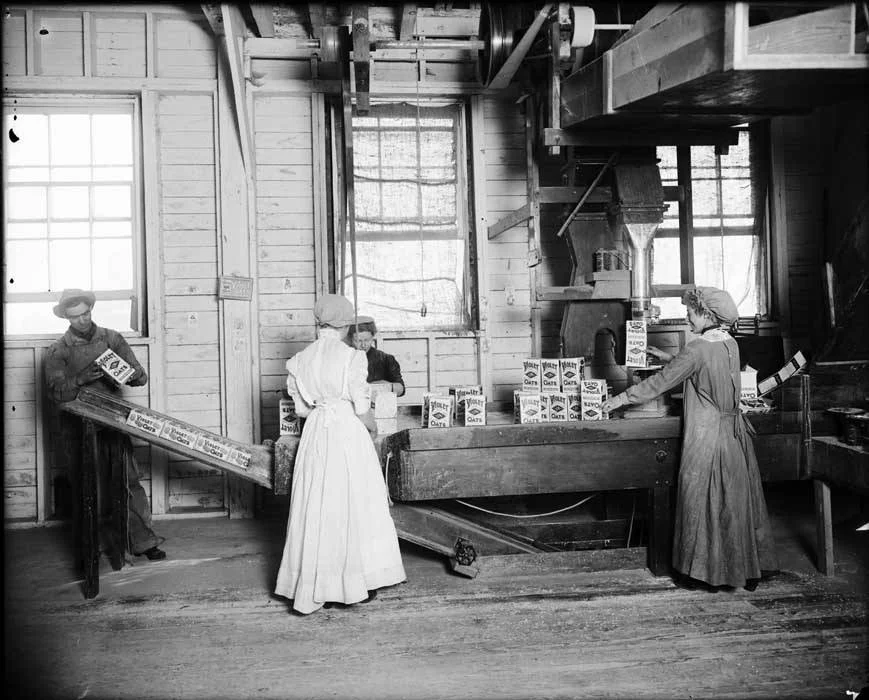
The old photo of oats being packed for shipment in Seattle shows a real place where things became units people could handle. It cannot tell us which modern supplier terms apply. It is a reminder that counting an item involves decisions about the forms in which it will be prepared and moved, not only the prices displayed to its eventual buyer. The present-day store can pay particular attention to the step at which cartons are broken open and counted into individual items. It is often where an apparent shortage turns out to have been a confusion of units.
The receipt does not always keep the supplier’s unit
If one case was ordered and stock software receives a line with the number one, the staff still need to know what that number counts. For movements into the shop, it may count cases. On the retail shelf it will often count individual units. Multiplying twice can make fictitious stock, and never multiplying can leave the system showing a shortage while six actual objects sit in front of it. A record mapping the supplier’s unit to the selling unit makes the decision repeatable.
Make the conversion visible on a return as well. Otherwise a parcel sent back as one case can look like just one unit left the storeroom.
Put the first order beside a later one
A simple comparison tracks what would be bought on the first order and what can be replenished later. Put the item, desired quantity, allowed multiple and line minimum on one row, and whole-order conditions at the end of the list. Then add when it would be sensible to reorder, assuming the products sell at a plausible pace. This makes a problem visible early: having to bring in twelve again when you are only one or two short may be much less convenient than buying twelve once. Some arrangements let quantities or order minima differ on a later order. The comparison only counts that difference if it is part of the actual terms.
A buyer can also ask about a split case, a mixed assortment, a trial order or a different item that fits their likely demand. Those are options to investigate, not things a supplier is bound to offer. When comparing an allowed alternate with a standard order, use the same period and the same likely products, and put transport and effort on their own lines. Sharing an order with another location can spread an order minimum. It should leave the parties clear about which items they are each taking and whether that arrangement suits the supplier’s conditions.
Walk back to the shelf for five notebooks. It gives a real limit but need not describe how the whole order was made. If an extra case is coming, someone needs to know when it will be wanted, where it will rest until then and what unit the buyer was quoted. An order that can be counted clearly before it leaves one business is easier to manage after it reaches the other. The useful task is to connect those two counts without asking the price per piece to account for everything in between.