The Next Farm on a Milk Route
A collection tanker can pick up the same total volume on two routes and spend very different amounts of time. Distance, stop time and saleable capacity each affect the haul.
In this story 6 sections
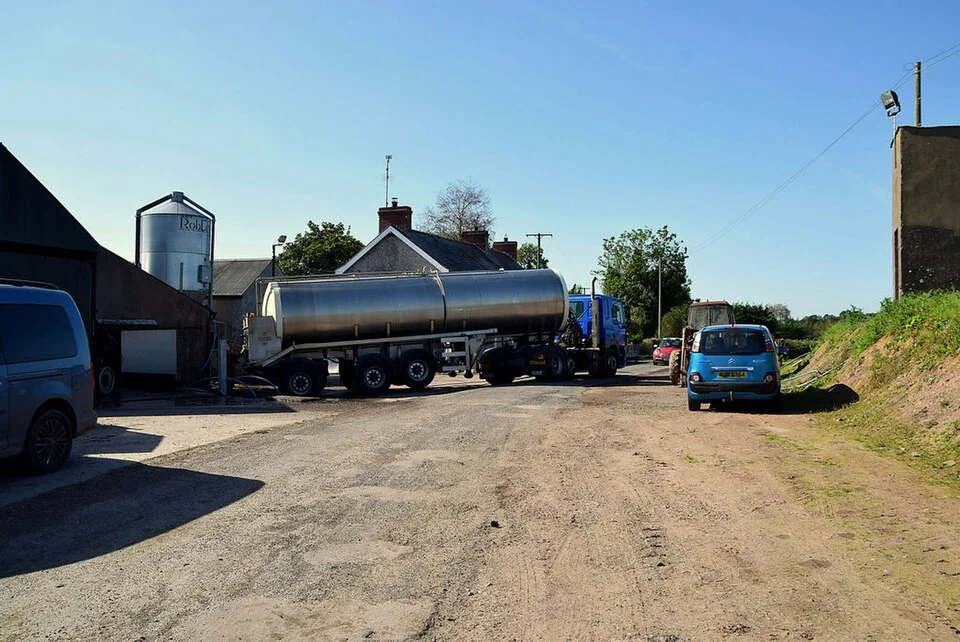
Kenneth Allen’s photograph shows a tanker at Kilnaheery. The tank is the large thing the eye picks out first, which makes it tempting to think of the work as carrying one full load from point to point. A collection route can have several starts in the course of a single trip. At one place the tanker receives part of the eventual volume. It leaves with that portion and can call at another before reaching the place that takes the combined load. What makes one of those trips inexpensive per litre and another more costly may have as much to do with the list of stops as it does with the size of the vehicle.
A farm usually cannot be moved closer to its next neighbour when the cost of a visit rises. A route can be arranged, visits coordinated and equipment sized to the available business. Those choices depend on how much is collected at each stop, when it is available and what capacity and time the route leaves for the rest. A price expressed per unit of milk can make all of that hard to see. The actual work has several units at once: distance, visits, hours and quantity delivered.
Which stop puts the next litre in the tank?
Suppose a fictional route collects 7,200 litres in three stops. A second route collects the same total in six. The distance might be similar on a map. The second driver still has to approach and depart three more collection points. Stop time is spent on a particular exchange, not on moving forward on the main road. It matters whether each farm lies beside that route or sends the tanker down a separate lane. It also matters how much has to be collected from the side of the route before the tanker can continue.
The useful comparison is usually between entire possible runs. A farm close to the start could add a relatively large available volume with a short diversion. A farm farther out might justify a long trip if its quantity is large and another group can be served along the way. One more pickup is not always a simple marginal action taking a fixed number of minutes. It might also change the destination or the order of other stops. It is a decision about how a route fits together, in addition to being a decision about adding an individual supplier.
This is why a count of farms does not reliably tell which route takes longer. The stops could be dense and easy to reach, or scattered across several roads with little chance to combine them. In one setting another stop might only occupy modest extra time. In another it could be the reason the tanker has to make a separate trip. Research on milk assembly has treated the collection process as a distinct source of costs; that focus helps keep the comparison grounded in what the driver and vehicle actually do.
The tank has a limit, and so does the schedule
Imagine a departure that collects enough milk early in its run to get close to the available capacity. A planned stop after that may have to change even if everything is geographically convenient. A different order of pickup cannot create capacity, though it can affect which set of stops fit in the same trip at useful times. The best route on an abstract map might assume that the amount each farm has available never changes. A workable schedule needs a way to deal with differences between one collection and the next.
At the other end, there has to be time to get to the recipient and hand over what was collected. An apparently efficient collection can arrive at a point when another tanker is unloading or when access is unavailable. A driver can be busy on the clock even while distance is not increasing. Businesses using a route need to know whether they are paying for a journey drawn between two endpoints or for an allocated period in which the vehicle is doing their work. An agreed capacity means little without agreements about when and where it is useful.
There are also circumstances in which the tanker already has room on a run and a particular new stop can make better use of it. The value of spare capacity depends on the new load sharing the conditions under which the other loads were accepted. Space for an extra amount does not settle those requirements. For a business comparison it helps to separate the availability of capacity from the terms and practical standards under which it can actually be used.
How the rate hides the shape of the route
Use imaginary costs to see the effect. Suppose route A uses 180 accounting units for travel and another 15 per stop for three stops. If the tanker delivers 7,200 litres, there were 225 units of cost in those parts of the example, or 3.125 units per hundred litres. Let another route use the same 180 units for travel and make six stops charged internally at 15 apiece. The second total is 270 units, or 3.75 per hundred litres. Both routes deliver the same amount and the illustrative differences do not come from a change in distance. They come from what the vehicle had to do along the way.
The example is deliberately narrow. It does not include all of a real carrier's costs or imply those prices exist. Actual arrangements can spread shared charges among farms in different ways. Some costs are tied to the trip; some to the quantity delivered; some to conditions at a location or a particular service. An amount presented as a rate per hundred litres can cover a mix of those costs. To compare charges at two farms, it matters whether the terms put distance, number of collections and volume in the same places.
An optional extra route illustrates why the average can be misleading when making a new plan. If the usual tanker is nearly full, adding a small amount could require another trip. Compare the cost of that whole trip with the extra quantity it delivers, then consider whether the route can include other useful collections. The original average per hundred litres offers little insight about the first few litres on an additional run. Conversely, using spare room with a compatible nearby collection might add much less cost than that average suggests.
Leave room for a variable week
The amount of milk available and the resources for collecting it can vary. Keeping a record of the planned and actual amount at each stop can help separate changes in supply from changes in routing. A delay might be caused by a slower stop rather than by the roads. If the route covers the same distance and spends much more time, an account concerned only with distance will miss the place to investigate. If the work took about the same time and brought much less milk, the cost per unit can rise even though the day's labour did not.
A contract can share the risk of those differences in various ways. An operator and a supplier can agree that a charge reflects a visit, an amount, distance or a combination. The more important point for understanding a bill is to know which event made the charge apply. A receipt for the net amount accepted by the recipient and a record of calls on the route are different documents. Read them together when the bill includes both kinds of work.
A new endpoint changes an otherwise familiar trip
A route planned to finish at one receiving site may have to be reconsidered when the end of the run changes. The last farm before the original site might have been a convenient final stop. Taking milk to another location can change its position in the itinerary and the time available to collect at other places. An old schedule can still be accurate about the quantities available and fail to describe the work of the revised trip.
A comparison therefore needs to let the route itself change as well as changing the mileage figure. One route could make better use of a group of stops by grouping them in a different order. Another could be easier to keep stable if it retains a familiar set of appointments. The cost comparison is useful when the promised collection and delivery arrangements are possible on the routes being discussed.
Follow the tanker before comparing totals
The photograph shows one vehicle and one setting. It does not show which farm supplied the most, where the tanker went next or how the work was divided among suppliers. A good explanation of hauling costs produces that missing itinerary in a form somebody can use. It relates travel and stops to the final quantity for which the trip was made.
Once the itinerary is clear, an apparent mystery can have a simple explanation. Two routes that deliver equal volumes may involve different work, and two similar costs per trip may be shared across different amounts. The next farm on the list matters because it will do one or more things to that calculation. It will add milk, use time and change the rest of the run. A rate per litre is most informative after those effects have been given a place in the account.