The Stems in a Florist’s Order
A wholesaler sells stems in bunches, a florist bills for an arrangement and a customer sees flowers in a vase. The three counts can diverge before one petal is sold.
In this story 5 sections
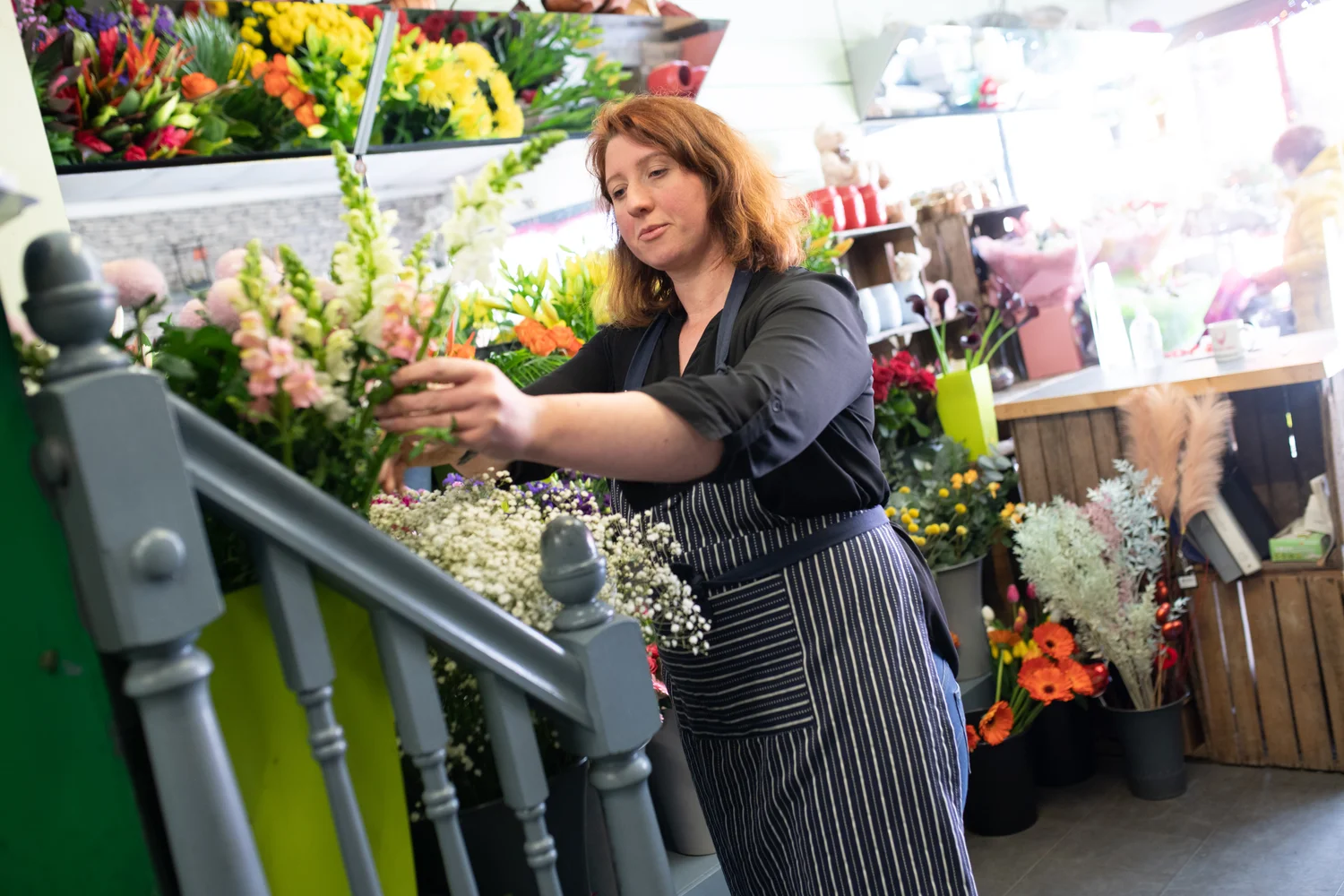
The florist in the photograph is reaching among greens and flowers in a space crowded with things that must be sold while they still look fresh. The hands draw attention to a moment between two ways of counting. Near the beginning of the chain there are stems sorted into bunches, often similar enough to go under one description. At the end there may be an arrangement that a customer ordered by size or occasion. It is priced as one item. Somewhere between those two counts the shop has to work out how many of the things it bought will be useful, and when.
Imagine an order for a group of low tables. The flowers have to stay below the eye line of people sitting across from one another. The same afternoon a second order calls for height on either side of a doorway. It is possible to use the same variety in both jobs. It may not be possible to use indistinguishable stems. The one below a row of faces asks for a head of the right shape and a length the florist can trim. The tall piece may require a long, straight stem that a lower grade or a different variety would not supply. Comparing how many blooms are visible captures little of the decision made at the wholesale counter.
What the supplier has made uniform
The Virginia Cooperative Extension guide to field-grown specialty cut flowers describes grading and packing as ways to offer a group of similar stems. The things worth comparing include length and thickness, the size of the flower and how far it has opened. The guide notes that bunches of ten are common for many species, while others may be sold in fives or singly. A florist cannot take a number advertised for one kind of flower as the size of a bunch of everything on a list. The unit has to be read next to the variety, grade and quantity.
From a buyer's perspective, grouping similar stems is a useful service. Ten that will reach to almost the same height can be used beside each other without building a support for one odd piece. Ten heads at a similar stage can make a group of arrangements look consistent at the start of an event. For an order that will be appreciated over several days, a deliberate variation in maturity can be useful, because each specimen need not reach full display on the same afternoon. The definition of a useful grade makes sense in the context of what is going to be made and when.
Notice what is being purchased beyond the name of the plant. A buyer may care how stiff the stems are and how they will hold a head where the design needs it. A bunch of a similar colour offered at a lower price could work very well at the low tables and poorly at the doorway. When the two jobs are combined in a single order, a sensible decision might be to ask the supplier for a larger group for the tables and a different specification for the tall stems. One quote with a higher average cost per stem could still leave less unusable material.
Count for receipt and recount for the job
Consider a fictional florist asked to make twelve arrangements using four prominent stems apiece. Forty-eight stems will be visible in those positions. If the desired material comes in bunches of ten, an order of five bunches gives just two spare stems. The arithmetic is easy to do at a desk. The question is what happens when the bunches are opened. A stem can arrive intact but be too crooked for one position, or a head can look acceptable when shaded by the rest and show damage once held apart. Stems that fail for one position may still work in another shop order. Counting them as interchangeable before inspection makes both jobs look easier than they are.
Suppose there is also an order for two small arrangements at the counter. Six bunches, or sixty stems, would allow the florist to choose the best fit for the forty-eight prominent positions and some for the shop. That proposal carries an extra bunch. If the counter arrangements have no buyer and the flowers that suit them are already far advanced, the shop may put additional time and money into stock whose value is disappearing. On the other hand, a reliable supplier might have another pack available close to the assembly date, letting the florist place a more modest first order without leaving the original commission to chance. Both examples depend on facts not contained in the price of one bunch.
A simple received count and a second count after sorting can teach different things. The first tells whether all the ordered units arrived and creates a chance to talk with the supplier about an error. The second tells the florist what can be done with them. Record what made an item unsuitable: too short for a requested height, open too early, damaged in transport, or merely spare. If each category is called waste, a careful buyer loses the information needed to make a different choice next time.
Time has to be bought with care
Extension material from the University of Massachusetts Amherst describes work between cutting and sale such as grading, bunching and keeping stems in suitable conditions. Practices depend on the type of flower and where it will go. The broad business point is that the treatment of inventory affects what will be available at the later hour when it is needed. If a box waits in heat or the stems are handled roughly, the amount a shop can use may fall even though the receiving note is unchanged. A business buying flowers to use on Saturday is paying attention to the time they arrive and the time they can spend in useful condition.
A difference of a day can matter in both directions. A florist may need a specimen to be open enough by the time a customer walks into a room. An early order can make that possible or make the same flower reach that stage much too soon. Some orders allow substitution by variety or tone where another flower will do the job. Some depend on a precise colour or a plant associated with a particular occasion. The room for a fresh purchase is different in each case. It helps to confirm which commitments are firm while they can still guide the order to the grower or wholesaler.
There is labour in that part of the process. People check the cut material, take delivery, sort what is needed for each commission, clean the materials they use to hold it and monitor how it changes. A customer may see only the quick part at the end where the flowers are wrapped. A large order may tie up enough work space that a second job cannot begin until the first leaves. Those costs belong in the reasoning even if the eventual bill presents everything in a single line.
The invoice ends with something the stems cannot do
The cost of a commission can include foliage, a vessel or wrapping, set-up or delivery, and labour. Its dimensions can be specified independently of the number of prominent flowers. A low arrangement sixty centimetres long and a narrow upright one use the surrounding space differently. Before looking at a wholesale list, a florist might ask what it should look like from the far end of a room and how long it has to travel after assembly. When one customer supplies a vase and another wants the shop to furnish it, the work of making the two arrangements may still be similar and the quotes may reasonably differ.
A useful estimate asks what happens if the quantity changes. Add an extra table and the designer may already have the spare stems, yet still need more of the supporting greenery or another container. Take one table away and the wholesale pack that was already bought does not necessarily become smaller. A price per arrangement can make a quote easy to read, but in the shop the units of procurement matter right up to the moment the commission is finished. A deadline for changing the count lets buyer and seller discuss that fairly rather than guessing which costs disappeared.
A related question arises on a quiet weekday, when the shop might aim for a display that can be sold in loose bunches or split among small orders. That flexibility can reduce the pressure to predict one exact demand. It also takes skill to plan: a distinctive flower that ties an arrangement together may be difficult to use if there are only two left. A flexible bunch has value only if the shop has uses for its parts at the hours they are still useful.
Keep the count where it earns its place
By the time the customer comes for the twelve arrangements, a stem count may have little use to them unless it formed part of what they specifically ordered. The buyer will notice whether the pieces match, whether they sit at the requested height and whether they are ready when promised. The florist can read those results against several earlier counts: how many stems arrived, how many passed sorting and where any extras went. Those counts can improve the next purchase in a way that the number of completed arrangements cannot.
The photograph belongs at that point in the discussion because the movement of one hand changes what the count is for. While choosing a stem, the worker is taking part of a supplier's bunch and giving it a place in a separate design. The flower still needs to look right from the room, and it still needs to last through the occasion. Paying for it in groups of ten is a practical way to move and sell it. Knowing where each one will be useful is what turns the purchase into a finished order.