The Economics of a Shipping Container That Goes Back Empty
Once a load has been delivered, the container itself still has to get to its next job. Its location, type and time out of use explain many apparently wasteful trips.
In this story 4 sections
At the end of a journey the consignment is unloaded, but one sizable piece of equipment remains. A shipping container is still useful and still occupying space. It may be somewhere with plenty of freight heading in the opposite direction, or somewhere with almost none. It may be the wrong size for the shipments that are ready to go. The company responsible for making the container available again has to decide when to wait, when to look for a different local job, and when to send it away with space inside it.
The resulting empty trip can look awkward because it appears to carry nothing of value. Look at the next loading location and the trip starts to make more sense. A box already standing near a factory or an inland terminal gives an export shipment a chance to take place on a particular date. Having the equivalent box hundreds of kilometres away does little for that shipment. The trip creates value by making reusable equipment available where it can next be loaded. It still has a cost, which explains why finding a suitable load for the return remains attractive.
Count arrivals and departures for the same kind of box
Start with two imaginary terminals. In a week, one receives a hundred loaded boxes and sends out sixty loaded boxes of the same type. Assume every box is ready for another trip by the end of the week and the totals are stable. Forty more have arrived than have left with freight. The first forty can stay in stock, but each week under the same conditions adds forty more. In the other direction, a terminal with the reverse pattern can run short. Positioning some empty boxes makes a difference at both places even when the ship’s next voyage would happen anyway.
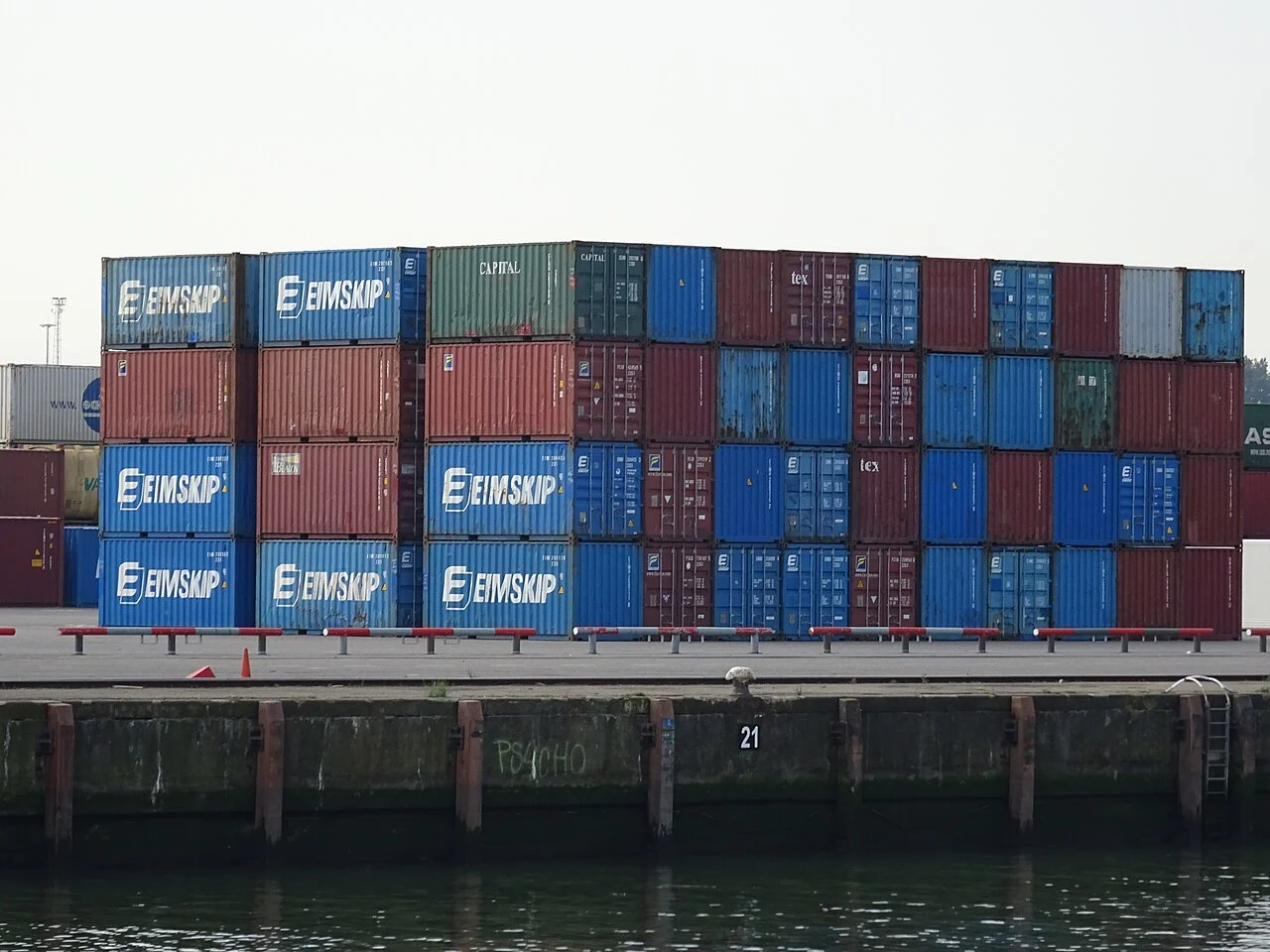
Now remove one of those simplifying assumptions. Some of the hundred boxes may still be in use with customers. Others may go out through a different route, or their construction may make them unsuitable for a shipment that is waiting at the port. A container designed for dry goods does a different job from a refrigerated unit that requires service and power. Availability figures become more informative when they describe which equipment is ready, under whose control and at which location. Counting boxes by eye says very little about any of those questions. The cover photograph shows stacks at Rotterdam and gives no information about the contents of individual containers.
Compare cargo imbalance with equipment imbalance. A region that imports more than it exports in value might send back many containers filled with goods that sell for less per unit. A shipment of high value might fit in a single box while a lower value commodity needs many. Similarly, the geographical boundary used to count the freight matters. Deliveries close to this terminal can generate boxes useful at another; freight categorized as exports from the same country can originate far inland. Ask which terminals, modes and equipment types the figures refer to before interpreting a numerical gap.
A box can be in the wrong place without leaving the country
Suppose a container brought by train to an inland city is emptied at a warehouse. A customer elsewhere in the same city needs that size of container, but has a different line’s booking or needs it at a time before the first customer can release it. Arrangements sometimes make it possible to move a box directly between suitable import and export customers. When they do, the equipment can skip a trip through a depot. Timing, responsibility for the equipment and its physical condition are part of making that match. A trip that would work geometrically can fail on any one of those details.
Even with a match, the box may need to pass through an inspection or service step before it is useful. The freight for one owner can demand a condition or cleanliness level different from the prior cargo. Access to the empty equipment is also a practical problem. A yard full of metal stacks has to identify and retrieve the right unit without unnecessary moves. Putting a box nearby is a more specific achievement than shifting it to a broad region on a map. Its position in the yard and the schedule of the next vehicle play a part.
Look at transport legs individually. A truck move from a customer to a depot, a move from a depot to a rail terminal and a sea movement all appear inside one broad description of “repositioning.” Solving one leg does not automatically solve another. Equipment might be readily available near a port while a customer inland faces extra cost to obtain it. Conversely, truck capacity used for empties on a particular day may be useful for balancing equipment later in the month. Time at one scale can be exchanged for convenience at another, and both may be visible to a dispatcher.
The booking can arrive after the useful sailing
Imagine a carrier can send a box away on Friday or wait until Tuesday in hopes that an export booking comes through. Waiting may save an empty move if the right load appears. If no load appears, the next chance to move the empty may be far enough away to miss a planned loading at the destination. An apparently economical decision to wait has a consequence when the receiving location would otherwise have used the equipment. A freight offer may also be attractive on the day it arrives and still be impossible to fit into the movement already required.
Costs sit on both sides of the choice. An empty occupies a ship slot or part of a train. Moving and handling it take time and resources. Keeping a stock of empty boxes requires land or use of a depot and can complicate retrieving other units. At the destination, a shortfall can postpone bookings or require an emergency move. The consequence depends on how much room there is in equipment schedules and whether another unit can fill the need. Written as a real choice, “send it empty” usually comes with the name of another place, a date by which it will be useful and a different cost for missing that date.
UN Trade and Development has documented how disruptions can strain the shipping network and unbalance the availability of equipment. A congestion delay can leave containers sitting at a port or customer longer than expected. It can also change the pattern of vessels arriving to take equipment away. The fleet has the same number of physical boxes just before and just after a delay, yet users at different locations can experience a sharp change in the equipment available to them. Timing accounts for part of the difference between total capacity and capacity a customer can actually book.
Consider a carrier serving three ports on a loop. From the port with spare equipment, the direct route to a shortage may have little space left this week. There may be more room on a vessel calling at a third port. Through that third port the box could reach its next job a few days later, or the connecting schedule might miss the job completely. A third port might also offer cargo that helps pay for one leg and leaves the box close to the final customer. This is why calling one route a return route can hide much of the choice. A box can find useful work on a path that never sends it directly back to the port where it started.
Long lead times influence the amount of equipment kept available as a cushion. If the carrier can obtain additional boxes on short notice, a small local stock may cover ordinary changes. If replenishment takes several weeks, the carrier has to look farther ahead or accept more risk of delay. Increasing that local stock can protect the service and use more storage. Reducing it can release space and leave freight exposed to an unusually busy week. An estimate using an average month helps set a baseline. The better check is what happens when releases and bookings swing in opposite directions for several days.
When comparing figures from two reports, see whether they count empty movements by the box or in twenty-foot equivalent units. A forty-foot box occupies a different amount of capacity even though it is still one physical object. A report about available boxes and a report about occupied ship capacity may therefore have different denominators. Use each figure for the question it was collected to answer.
What a yard full of steel can tell you
Ask three questions when you see a crowded terminal: whose slots are being used, whether the equipment is ready for use, and what has to happen to it next. A high stack can represent plenty of future opportunity or a collection that cannot be used in the way a particular shipment requires. Waiting for a clean matching container can be more decisive than the presence of hundreds of other boxes. A count grouped by model, owner and release status is better evidence than a panoramic image.
A useful description of a route also gives the direction. Demand in two directions does not need to be equal to produce productive return journeys. A relatively small flow of reliable matching cargo can help, and carrying cargo on the way can compete with delivering an empty quickly to a different destination. An equipment decision travels alongside a freight decision. Following the container through its unloaded period makes it easier to see where those decisions join again. That is the leg in which a steel box whose first job has finished becomes available for its second.