What a Frame Shop Measures First
A picture frame quote starts with several sizes, not one. The distance between the paper and the outside edge determines how much material the shop buys and how it spends its time.
In this story 5 sections
A person brings a print into a frame shop and says it is twenty by thirty centimetres. That might be the size of the paper, the size of the printed picture or the size they want on the wall. If the number came from the original listing, it may describe the paper alone. There might be a white edge and a signature below the picture, both of which the owner wants people to see. The framer measures the sheet and then asks what should be visible. By the time the conversation reaches wood finishes, the two have already made decisions that will affect almost every line of the price.
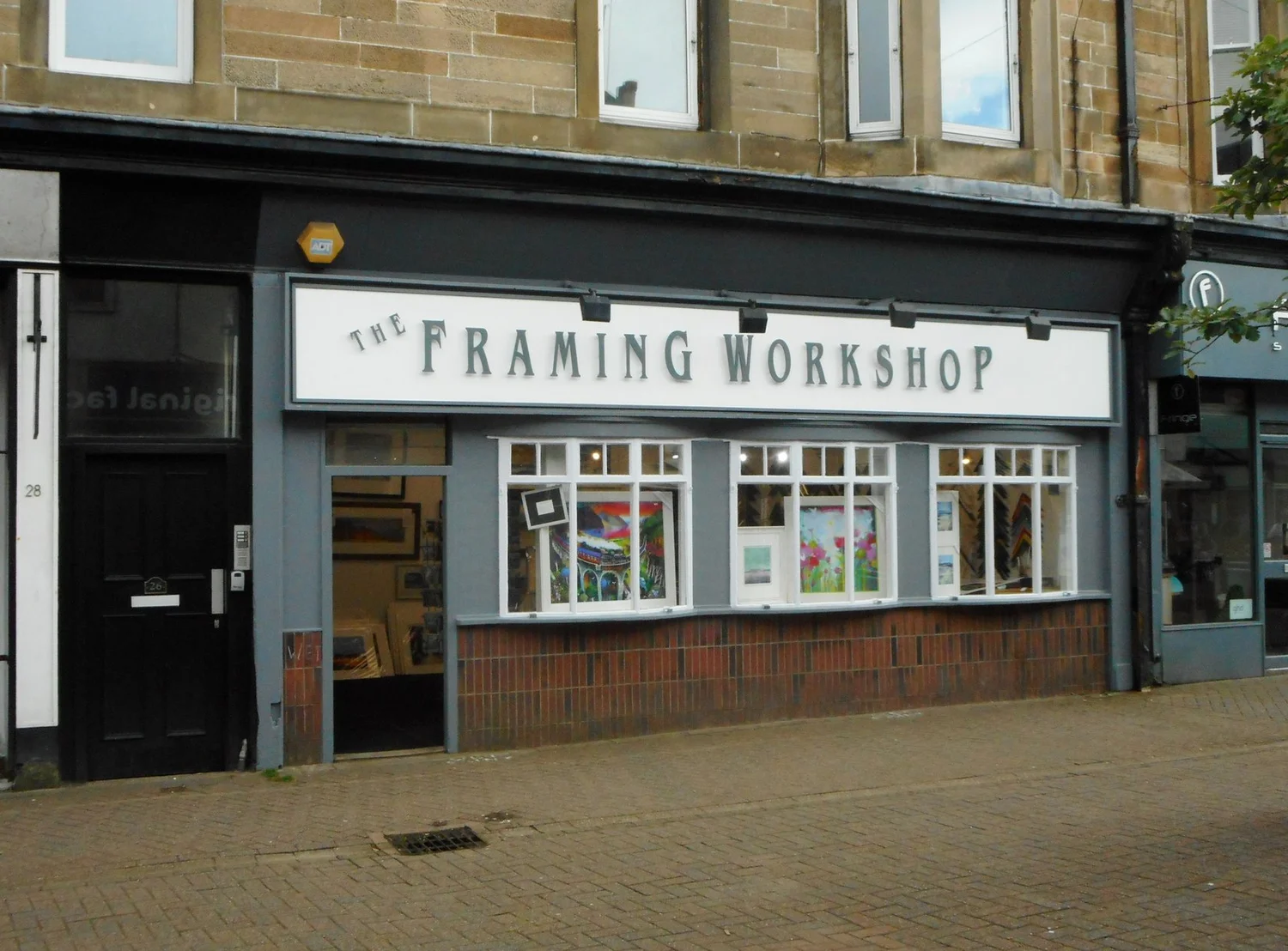
The storefront in Richard Sutcliffe’s photograph stands between buildings on an ordinary street. It gives no view of the cutting bench or of the materials stocked there. There is no way to infer its prices from the picture. It is useful for a different reason: the finished frames displayed by this sort of business can make the making of one seem like a choice among corners arranged on a showroom wall. A useful way to understand custom work is to follow the dimensions from the paper outward and ask at each step what has to be cut, fitted and checked.
Start at the piece of paper
Picture a sheet twenty centimetres wide and thirty centimetres high. An image printed on it measures sixteen by twenty-four. One owner wants the image to fill the opening. Another wants to see all four paper edges because the deckle is part of the work. A third wants the pencilled edition number and signature outside the image to remain legible but can live with the unmarked outer edges covered. Those are three jobs even though each owner brought the same size sheet. The opening in the mat, its visible border and the method holding the paper in place can all differ.
If a mat overlaps the paper, the framer needs enough sound margin for the arrangement to work. If the owner wants the whole sheet exposed, the shop may propose a different mount and some separation from the glazing. A quick measurement at the counter is not always enough to settle which arrangement is suitable. A print might be a cheap modern reproduction or a drawing that matters to a family and cannot be replaced. Its corners may be weak, or its surface may be friable. A careful shop may ask about the object before committing to a mounting method or give a conditional estimate if it has only seen a photograph.
The distinction is worth recording in plain language. For example: show the signature and the image, cover the blank outside edge, fit the finished frame into a space on the wall forty centimetres wide. One short instruction contains three different kinds of measurement. A quote that specifies which one has been measured is easier to compare, and it protects both parties if a decision changes before work starts.
Wood runs around the outside; glazing fills the middle
In a simplified example, suppose the outside of one proposed frame is thirty by forty centimetres and the outside of another is forty by fifty. The corresponding outside perimeters are 140 and 180 centimetres. This calculation is an illustration of how much more distance the second set of rails must cover, not a cutting list. A shop cuts four pieces with mitred ends; the exact lengths depend on whether measurements are taken at the inner or outer edges and on the profile of the moulding. The length sold in a supplier's stick may leave an offcut. A knot, a defect in the finish or a corner where a pattern would fail to meet can limit which portion of a stick can actually be used.
A pane or sheet, by contrast, fills an area. Even if the shop stays with the same wood profile, changing the size of the package affects how much glazing, board and backing fit on its bench. Those materials sit inside the frame, so they do not extend to the outer size used to show the perimeter. In a separate example, a glazing sheet thirty by forty has an area of 1,200 square centimetres and one forty by fifty has an area of 2,000. Material costs do not necessarily follow that ratio either. Two smaller pieces might fit across stock a shop keeps on hand, whereas a slightly broader one may force it to open a second sheet. The amount ordered, the amount used and the amount charged for can each be different.
The outer dimension has a practical use regardless of the quote. It tells a customer whether the frame will fit between a cupboard and a switch. It tells a shop whether it can fit in a standard collection box. If somebody changes from a slim metal frame to a deep wooden one, it is useful to check that size again even if they have asked for exactly the same visible opening.
What the bench time is for
Once the order is agreed, somebody still has to cut and join the rails, cut the opening if there is a mat, clean the glazing, put the contents together without shifting the paper, check the surface in good light and fit any appropriate hanging hardware. These tasks are related but not all proportional to width. A small frame still has four corners. It can take nearly as long to settle on the opening for a small, irregular drawing as for a broad poster. A tall frame can add a different kind of time if a second person has to help handle it or the workbench needs to be cleared for it.
For a pair of similar pictures, some of that time can be shared. The framer can check both against the same samples and prepare the mat cutter for the same dimensions. There are still two sets of rails and two pieces of glazing. Comparing the quote for two identical dimensions with a quote for two individually sized objects can show why two orders with the same number of frames might have different prices. The repeatable part is the setup, and a business that makes enough matching frames in a run can build that saving into its calculation.
A shop can also know how long the assembly takes and still need to wait on an order. If a particular finish is not in stock, the work cannot begin when the art is dropped off. A collection date estimates elapsed time; the labour line estimates the use of the bench and people's hours. Asking about an in-stock alternative may shorten the first without changing the second much.
Preservation changes the specification
The Library of Congress gives preservation guidance for works on paper. It discourages long-term permanent display of valuable paper originals because exposure to light can cause permanent damage; a well-made reproduction is an option. If the original is to be framed, the choice of board, the method of attachment, separation from the front glazing and the back of the assembly matter. This is a different conversation from deciding whether a poster from a shop can use a frame already in the house.
Terms such as conservation or museum may appear in a quote as product names or shorthand. Ask what the proposal includes and how the paper will be supported. It matters whether the offered change is a particular type of glazing, a choice of board, a different mounting method or several measures together. No specification of the pane alone settles where the finished piece should hang or how much light it receives. For an object in poor condition, it may be appropriate to have a conservator examine it first rather than treat framing as a repair.
Scope affects cost here in ways invisible from across a room. A window mat and a spacer may both keep a surface away from the glazing, but they do not look alike or necessarily put the same demands on the rest of the package. A deeper stack requires a profile that can accept it. A shop cannot exchange pieces on the order freely once a change alters the depth or the way the original can safely be supported.
Comparing two estimates at the counter
For the twenty by thirty sheet, imagine one estimate offers an existing standard frame with a custom window mat. Another offers a made-to-size frame and an arrangement that shows the whole paper edge. The first may economize on stocked parts; the second answers a different question about display. It is fair to compare the cost once the two shops are asked for the same visible area, material choices, whether the work is mounted, the outside size and any collection or delivery arrangement. A customer can also keep both offers and decide that the visible paper edge isn't worth the extra work for this particular item.
The reverse comparison is possible. A shop may suggest reusing a frame already owned by the customer. That can save on new moulding, but someone should still check whether the existing rails are sound, whether the pocket is deep enough and how much work it will take to fit the new contents. A ready-made frame is a component the customer can bring to the bench, rather than an automatic answer to all the measurements. If the fit is good and the priorities are clear, it might be the best basis for the job.
The useful number on a frame-shop ticket is the one attached to a stated purpose. The sheet dimension identifies the object. The opening describes what a visitor will see. The outside dimension tells the customer how it will meet the room. A clear quote carries all three from the discussion at the counter into the workshop, so the person cutting the last corner is doing the same job the customer agreed to pay for.