What a Window Cleaning Quote Counts
Glass area is easy to put into a spreadsheet. The cost of cleaning it also depends on which faces are included, how they can be reached and whether the visit can fit around the people inside.
In this story 6 sections
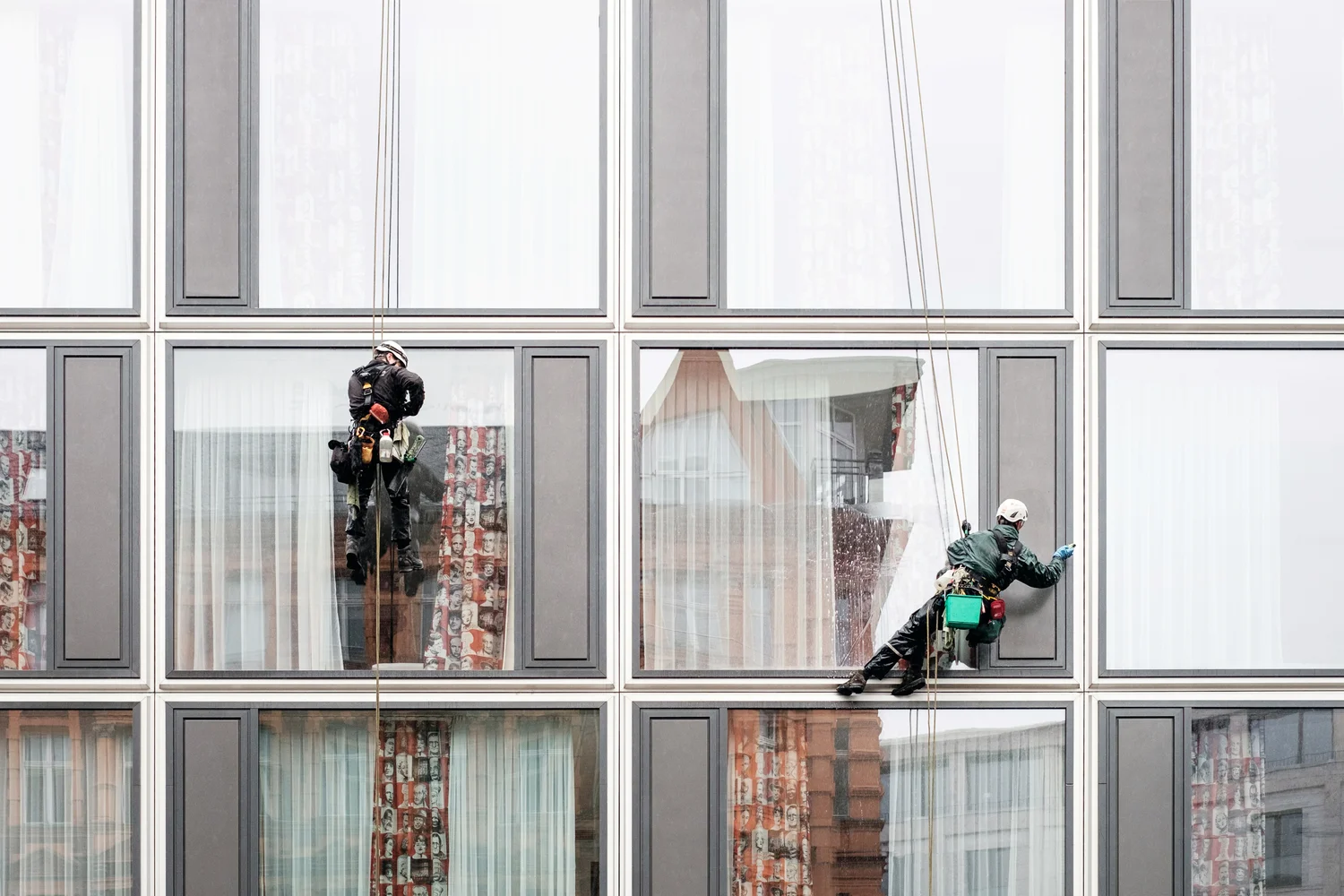
The window cleaners in Samuel Zeller’s Berlin photograph are visible as two small figures against a large arrangement of glass and frames. The building's repeated panels invite a quick count. A visitor could probably count the ones in a particular row without knowing how anybody reaches them. From the point of view of a person preparing a quote, that difference is where the work begins. Counting glass tells you part of what needs cleaning. It says almost nothing about how much effort it will take to put a worker or the appropriate equipment in a position to do it.
On a smaller building, the same issue can be easy to overlook. A shop might occupy one floor and ask for its front windows to be cleaned. The quote could refer to two sides of the glass or only the exterior. The bottom panel may be easy for a contractor to reach while the upper one has a sign or canopy partly in the way. The amount of glass is useful to know. Before it becomes an estimate, it has to be attached to a description of surfaces, access, time and the intended result.
Define a window as the customer and the crew see it
A person describing a building may say it has twelve windows. Another person may count the individual panes where features divide the glass. A third may estimate the area on a drawing and use one length of the façade as a starting point. The three approaches can be useful in different contexts. A large continuous sheet has a different amount of glass from a small pane. Many small pieces can also require attention to more edges or frames across the same total area. A numeric description of quantity should be attached to something both sides of the estimate can recognize.
Then there are faces. A single pane might present an exterior surface to the weather and an interior surface to a shop full of displays. Cleaning the outside does not give access to marks or deposits on the inside. An inside visit may have to work around a line of tables, shelves or merchandise. Someone can see both kinds of mark while standing in front of the glass. A quote for one side can look quite different from a quote for both even though the pane is the same object on the building plan.
Include details such as frames, sills or an agreed treatment for material stuck to the glass if those are part of the desired work. Different requests make different use of the booking. A quick recurring wash that leaves frames to a separate visit is not equivalent to an initial job that includes more preparatory work. A useful way to compare estimates is to describe what a customer will see after the visit, then confirm which steps and surfaces each quote includes.
One long side is not always one long task
At a level storefront a crew might be able to work along most of the glass from one side of the building. In another case a canopy, wall or change in ground level can divide the visit into several parts. Work might also need to be coordinated to keep a public entrance or walkway usable. The Health and Safety Executive's information for Great Britain explains why access arrangements depend on site conditions, height and the work involved. The commercial comparison is broader than any one method or regulation. Someone has to judge how the work can properly be reached before the proposed hours are meaningful.
Think of two fictional premises with the same glass area. In the first, a crew can work continuously along a straightforward frontage at a convenient time. In the second, somebody has to arrange access to several separated areas, pause as people pass and leave a different group of windows for later. The amount of time spent making glass clean might be very similar. The amount of time for which staff and equipment are occupied can be quite different. A square-metre rate that ignores the distinction won't explain why one job costs more.
Before assigning a cost to access, specify what is known. The customer can identify opening hours, the expected arrangement of the entrance and who can admit the crew to occupied areas. A contractor determines suitable access for its people and equipment. A photograph can help make the condition visible and still require confirmation. A route that looks clear on a day the shop is closed may not be clear when the work is planned.
Separate the first visit from the regular rhythm
A first visit can reveal that an estimate assumed ordinary accumulated marks and the windows instead need work to deal with material left by a different activity. There may also be time to check which surfaces can be reached at the hours the customer proposed. It helps to ask whether the price covers getting the site to an agreed starting condition or maintaining it after that condition exists. A recurring visit can be predictable precisely because somebody has already learned the layout and repeated the work under comparable conditions.
Some sites prefer frequent work on the areas customers look through and less frequent work on upper panels. Another site may want everything done at once so that it has fewer separate visits to arrange. The choice affects both sides' schedules. When comparing annual costs, check the number of visits, what each includes and which services happen less frequently. An average per visit can mislead if one supplier uses the same words for several different sets of surfaces over a year.
The same pattern can affect a quotation for neighbouring businesses. Two shops may be able to coordinate visits so a crew is already nearby during each. The work on one premise still has its own requirements. A saving, if one is offered, depends on what time and preparation are actually shared. It cannot be inferred simply from writing two addresses on the same page.
Find the unpriced parts of the visit
Imagine a small shop where the owner wants the glass clean before the first customers arrive. The requested hour may be a real condition of the job. A different offer could assume that work can begin later. Agree who will unlock the building, which surfaces will have space around them when the crew arrives and how the glass will be checked when the visit ends. Jobs to which the customer contributes some preparation are not quite the same as ones that require the cleaner to do all of it.
A delay need not have anything to do with how long cleaning takes. A missed appointment for entry ties up a crew while no glass is touched. Weather can affect work outside or a particular approach can become unavailable. A service agreement may state what happens in those cases. A useful record can say when and where the work happened and what portion remains. That is a better basis for arranging a return than the broad conclusion that a visit either succeeded entirely or never happened.
Work through one deliberately simple quote
Suppose a fictional premise has two groups of windows. A first plan calls for six outside-only visits to the group facing the street, at sixty abstract currency units each, and two inside visits to the same group, at fifty each. The quoted annual total for that group is 460 units. A second figure of eighty units for a visit including both faces looks more attractive at first glance. If the second offer is for only four visits a year, its 320 units buy something different: fewer exterior visits and more visits inside. Neither figure answers the buyer's needs until the timetable and the faces have been compared directly.
The other group of windows in this example might face an enclosed courtyard and be omitted from both offers. That can be an intentional decision. It becomes a problem if the customer reads windows as all glass belonging to the premises while the contractor understood it as the frontage. A brief list of the surfaces or a marked drawing can prevent this particular mismatch. It is more useful than asking two contractors to return numbers from an address and comparing whichever numbers come back first.
Finally, replace the invented units with a real quote only after settling how exceptions will be handled. Ask whether a visit with only partial access will be recorded as completed or rearranged. A price supported by that answer is easier to compare than one that assumes entry and weather are never a problem.
Put the units beside the work
Return to the photograph's tidy grid. The same count of panels could occupy a methodical sequence for people at the site or represent only the visible fraction of a more complicated contract. The glass area and number of panes still matter. Their meaning becomes clearer once someone specifies how the work can proceed, which sides belong to it and which time it can occupy.
A customer comparing prices does not have to reconstruct the contractor's entire method. The useful questions are whether both arrangements describe the same glass, include the same access conditions and leave it in the same agreed state. If an estimate shows where time has to be spent as well as how much glass there is, it explains its price in a way the face of the building alone never could.