What a Shop Does With Someone Else’s Parcel
A staffed pickup point lends space and working time to a carrier. Whether that helps the customer, the shop and the delivery route depends on who does the work that remains.
In this story 5 sections
At a shop that also handles parcels, somebody can bring a box to the counter without buying anything there. From across the room it looks like a short transaction: find a box, verify that it is the right one, record the pickup. Between a delivery in the morning and a collection after work, the box has occupied a few minutes of attention and part of a shelf for several hours. The carrier's work is not the same as the shop's. Both have contributed to the last part of the trip.
DPD in Germany and UPS in the United States describe services in which eligible parcels can be collected from participating shops or other access points. Their examples show why the familiar name of a shop and the name on the label need not match. A courier has made a handoff. The shop is a temporary custodian, while the recipient has a final journey to make. This arrangement can be convenient without making the time and space between those stages disappear.
Two shops can do very different work under a similar sign
A staffed parcel counter might accept labelled returns as well as hold deliveries for pickup. It does not automatically provide packaging, print labels or sell every service the carrier offers. UPS distinguishes its participating retail partners from fuller service locations in its own information. That is an important distinction for a customer approaching the counter. The address identifies where to go; it does not describe every operation possible at that address.
The same distinction applies to a shop and an unattended locker. A locker has a fixed set of compartments; a staffed shop may use shelves or other storage and have somebody find items manually. Either has a limit. A box that will not fit or is outside the carrier's terms cannot necessarily go there just because the collection point has a spare address. Separating the kinds of pickup also explains why hours, documentation and handling arrangements need to be confirmed for the actual shipment.
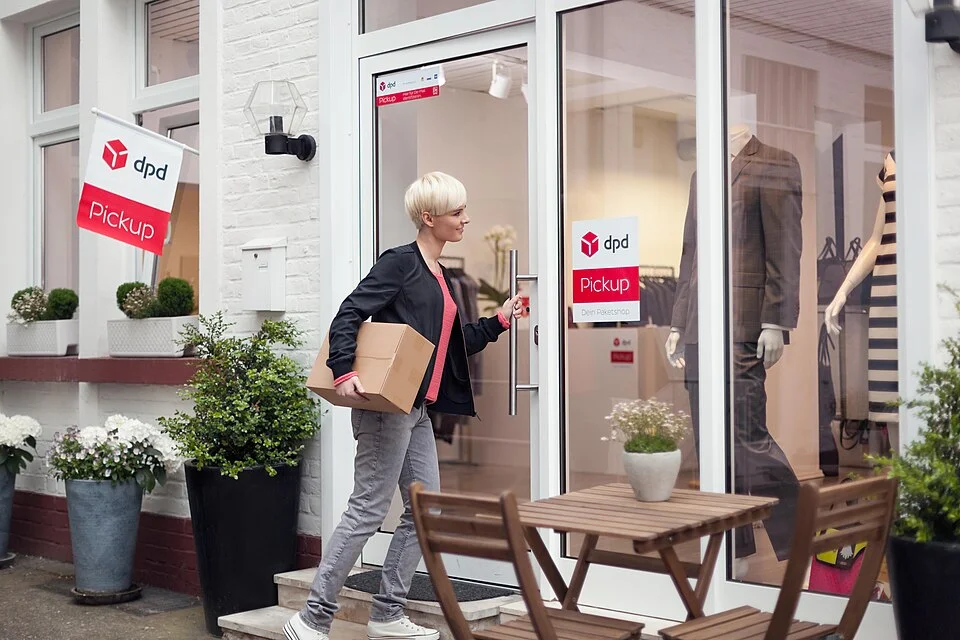
A sticker can use a large logo and still leave these questions open. An official pickup confirmation can be more useful if it names the complete location, access window and necessary proof. A sign at the door can do a separate job: direct incoming people to the correct counter before they join a queue. How the two pieces of information work together can matter as much as the carrier's selection of sites on a broad map.
A box on the shelf has a clock attached
For a deliberately simple example, suppose a fictional shop receives twelve parcels a day and that nearly all are picked up on the day after arrival. A shelf must fit the boxes left from the prior delivery while it receives the next. If outgoing customers tend to come in the evening and the morning batch arrives early, the peak might briefly include nearly two groups of parcels. An average count at closing would miss that overlap. The fictional numbers are not a storage recommendation; they show how the time sequence can matter before any particular package becomes hard to place.
A few delayed collections make a different pattern. Shelves that can handle a steady turnover can fill when several customers postpone the last trip. Larger boxes create an additional wrinkle because a count of parcels does not measure the cubic space they occupy. A shop comparing two weeks of work could record the largest count at a busy time, the amount of usable space and the number of boxes held for more than one usual interval. Those three measures tell different parts of the storage story.
DPD's recipient information notes that a parcel can be routed to a different shop if the expected one is at capacity, and that opening hours vary by location. The carrier's own notice and shipment information give the pertinent time conditions. A shop cannot decide from the label alone whether a specific parcel may remain past a stated cutoff. Return to sender, transfer and continued holding may be handled under different rules. Those events should remain separate in any account of what occupied the shelf.
Time at the counter is not evenly distributed
A person collecting a parcel can arrive while several other shoppers are making regular purchases. The number of pickup minutes in a day might look small on paper but still overlap with the busiest trading interval. Conversely, a steady flow during quiet periods can be easy for staff to manage. If a shop owner wants to assess the work, a tally of transactions alone is less helpful than knowing when people arrive, how long it takes to locate items and how often someone needs help with a missing notice or an incorrect address.
Suppose the fictional shop records an average of two minutes for each of twelve simple pickups. That is twenty four minutes of counter time. It does not mean the shop automatically hires someone for another twenty four minutes. The staff might fit those tasks between existing jobs. They might also have to stop another task precisely when it is least convenient. Distinguishing total work from the cost of fitting it into a crowded period helps explain why two shops might have different experiences with the same number of parcels.
A parcel service can bring more people to the shop. Some may make a purchase; some may not. A claim that every pickup produces additional retail business treats the step through the door as a sale. A fair comparison would track actual purchases and recognise that regular customers may already have intended to stop. If the shop earns a separate amount under its agreement, that is another line of the calculation. None of the terms of the shop pictured on this page can be inferred from the fact that it displays a carrier's sign.
The carrier and the customer take different journeys
Delivering several orders to a single access point can reduce individual stops along the portion of the carrier's route involved in that handoff. It also changes where recipients travel. Someone already passing the shop can combine collection with other errands. Someone who selected home delivery and later learns the parcel went elsewhere might have to make a trip they had not planned. The arrangement moves time and distance among people; that is different from proving it saves the same amount for everyone.
This shows up in a simple comparison. Count the movement from a loading vehicle to the pickup point and then decide what travel is still required before the parcel reaches its recipient. Do not stop at the word delivered in a carrier record without asking what the status means. In one case it could mean delivered to a home. In another it could mean ready at a shop. Both can be valid descriptions of what the carrier has completed, and only one might place the box in the customer's hands.
A customer can find the service much more predictable when the handoff is explicit. Where is the package now? Is there a delay before collection is possible? How long is it held? Can the site handle a return as well? These are separate questions. The solutions can be modest: instructions in a notification that match the shop's name and posted hours, and a status that distinguishes arrival at the pickup point from final collection.
A record of who has the box keeps the service intelligible
Returns give the space and labour calculation a direction of its own. A customer deposits a box, but the courier may not collect it until a later visit. Incoming parcels waiting for their recipients need storage at the same time as a separate supply of outgoing parcels. Counting a return as simply the negative of a delivery misses that both occupy space. A full rack can contain packages that will leave by different routes and require different scans before either route can begin.
Separate these flows in the fictional tally. Twelve deliveries might share the room with five return parcels already accepted earlier in the day. The shelf must hold both before the next collection, even if the counter completed very few customer transactions that hour. Good records tell staff which parcels should be released to recipients and which wait for the carrier. A low transaction count does not mean there is spare room to accept a sudden new batch.
The last person working the counter needs to find the correct package rapidly, follow the applicable checks and record what happened. A carton looks different from a label on a phone. If two packages have similar outer boxes, a staff member needs an identifier rather than a guess. The receipt or status visible to a customer is valuable because it provides a later point of reference, even if it cannot explain every operation in the distribution network.
On a busy day the shop may not appear to be doing anything different from selling goods from its usual shelf. The box still enters and leaves, and a record follows it. The key distinction is what the intervening visit buys: somewhere to hold an item, a person or system to handle it and a time at which collection will be possible. The little logo at the entrance announces access to those things. The shop's actual work is measured in the intervals between them.