What a Survey Crew Does Off Site
A tripod makes fieldwork visible. Finding records, processing observations and checking the finished drawing take time that an estimate based only on the visit misses.
In this story 5 sections
From the road a field appointment may look easy to price. Somebody sets up an instrument on a tripod, talks to a second person carrying a staff and takes a series of measurements. By the time the vehicle leaves, nobody else at the site can see much work continuing. It may still be necessary to compare observations, assemble a drawing, check the results and deliver a file another person can use. The van's departure is as useful a milestone as arriving. It is a poor definition of completion.
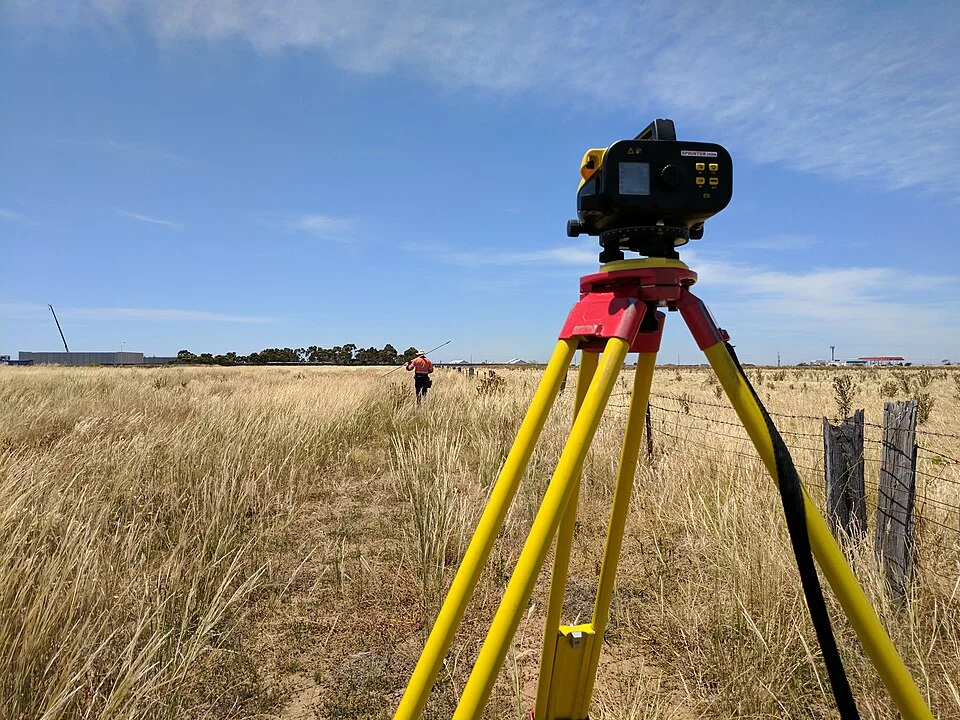
The United States Bureau of Labor Statistics describes surveying as both fieldwork and office work. It notes work with measurements and records as well as the use of equipment in the field. This article uses an invented small site measurement job to show how those activities can appear in an estimate. It does not give rates, declare a boundary or replace a surveyor for questions that require licensed work under local rules. The photograph shows a technician and an instrument in the field, one visible part of that process.
Start by asking what the customer will receive
For an illustrative task, imagine a local organisation asking for a drawing of existing features on a small site so its staff can discuss a future layout. Someone may say they want a survey while having in mind measurements at a few points. Another customer may expect a file with named features, elevations and a stated reference system. The measurements required for those outcomes differ. Before time is estimated, ask what output is being requested and what purpose it has to serve.
The distinction is practical rather than semantic. A person who needs a drawing to use with existing mapping may want it in a particular file format and reference system. A colleague simply comparing two room dimensions might find a different level of documentation sufficient. The time spent in the field cannot be interpreted without knowing which answers must be checked and retained. A drawing intended to locate a particular change must be able to show it in a way the recipient can use.
In particular, a drawing of visible features is not the same service as determining the legal boundary of property. That work can call for specific records, expertise and formal procedures according to the jurisdiction. A sign at the site or a neighbour's recollection is not a substitute for the relevant professional evidence. Defining the purpose up front helps both parties avoid counting work on one kind of question as if the resulting file resolved another.
The directions to the field apply to the estimate too
A visit can involve access arrangements, travel, setting up and working within the physical conditions on site. A measurement point that looks easy to reach from a picture taken in summer may be behind ground the crew cannot enter on the booked date. A building or vegetation can change which positions offer a clear sight line. A person quoting the work might want to identify what access has been confirmed, which features are wanted and what happens if an expected part is unavailable.
Use a deliberately simple calculation. Suppose a two-person team visits for three hours including its on-site setup and checks. That is six person-hours on site. A description of three hours in the field is an elapsed time the client can recognise. It is not a complete sum of all labour. If one worker uses another two hours to prepare and process records and a second spends an hour checking the result, the example has nine person-hours before any differently counted travel or additional work. The value of the arithmetic is to name what was counted, not to choose a rate for it.
Two jobs with identical elapsed hours could ask for different levels of attention after the visit. A simple requested list of measurements may need less drafting than an annotated and checked drawing. Another job might call for comparing existing records or revisiting an observation that fails a check. An estimate that says only three hours has left the reader guessing whether the difference between these jobs was part of its scope.
Checking a result needs its own time
Take a fictional case in which two observations agree at one part of the site but leave a surprising difference elsewhere. The person checking the file needs to know how values were recorded and which point each one belongs to. Was a feature observed from two positions? Did the notes use the same name for two different objects? A check may require resolving a small notation problem or finding a missing observation. Counting a first line on a drawing as the finished job leaves little room for finding that difference.
The destination of the file can also create work. If the measured features need to be compared with an earlier drawing, another person has to be able to identify which references and conventions were used. Units, labels and the date of observation belong with the result. A clean plan without those details can look adequate on screen and be difficult to join with the rest of the project. Preparing a file another person can check is a separate task from making it attractive.
An outside reviewer could ask what portion the field crew has confirmed, what was supplied by others and which areas were not accessible. A useful result can distinguish them visibly. Adding a blank or an explicit limit does not make the drawing less professional. It keeps a viewer from inferring a measured feature in a part of the site no worker observed. Time spent defining those boundaries is one way to see the work behind the delivered pages.
What changes when access or the output changes?
Suppose a fenced side of the fictional site is not accessible during the visit. It may be possible to deliver a described subset, reschedule the missing work or agree on another solution with qualified staff. The choice depends on the task. The quote can make it clear whether a further visit is already included or would require approval. A photograph of the tripod gives no information about which of those arrangements exists.
An additional request can change the job even without another field visit. If the existing observations support the new question, somebody may be able to produce a different view from them. If they do not, the request may require more measurement. A customer who says they already paid for the visit has identified one part of the original price. They still need to know whether the new deliverable was part of what the visit was planned to collect. That question is much easier to answer with a named scope.
Put the quote beside the visible work
An off-site estimate can include time spent finding useful input before any observations are taken. A client may have supplied a plan with no date, no units on its copied sheet or an identifier that refers to another area. A worker can make progress by identifying it or asking for a more suitable record. If the client wanted the new result aligned with that plan, resolving the input is part of the requested task. It is not work somebody can assume already happened because they received an image of a drawing with the inquiry.
There is a real choice about revisions too. A client can ask for one round of corrections to an agreed drawing, for a different file type or for additional features never requested. Those are three different things. The estimate can specify how the first delivery will be reviewed and how further work is agreed. A rule as simple as confirming any requested extra field visit in writing can keep an important decision visible at the place it arises. The object measured outdoors might be the same; the work required after receiving a new instruction need not be.
For a repeat assignment, keep the quoted and actual work side by side. Note whether extra time came from a different site condition, a more elaborate drawing or a late change in scope. That record does not need minute-by-minute surveillance to be useful. One clear reason makes it easier to estimate a comparable job and know which assumptions can safely be carried into it.
A useful estimate lists the intended deliverable and the premises of the visit. It defines or separates work on initial information, field observation, processing and review, to the extent those distinctions help decide what is included. It also says what will happen when access or the requested output changes. The requirement for detail can be modest, especially for a small job. The aim is to prevent a visible part of the work becoming a misleading unit for all the work.
The tripod makes a satisfying marker from which to start reading the process. It is a specific object placed on real ground, and someone needs time to get it there and take it away. The end of the job belongs at another point: when measurements have become the agreed result and can be understood by the person who asked for them. Estimating both the conversation before the visit and the work afterwards makes the field hours mean what they are actually meant to mean.