When a Copyedit Is Priced by the Word
Two manuscripts with the same count can take different amounts of work. A useful quote tells an author which edit is included and how changes to the job will be handled.
In this story 5 sections
A word count is a convenient thing to have before two people agree on the price of editing a manuscript. It takes moments to obtain and can be supplied without a long description of every sentence. But rarely is time distributed evenly among the words. An editor can pass through a clean paragraph quickly and stop for several minutes over what two authors mean by the same abbreviation. When the job is priced by the word, the useful question is what estimate of that uneven work lies behind the rate.
The Editorial Freelancers Association distinguishes copyediting from other services, including later proofreading. Its material describes copyediting as work such as correcting usage and punctuation, attending to consistency and checking cross-references. A client who wants major structural rewriting may be asking for a different service. A client who needs to check a designed final proof is asking for a different stage. Those distinctions determine what somebody intends to buy before a word count enters the estimate.
The example starts with a version of the file
Take an invented manuscript of 18,000 words. Suppose a copyeditor offers to do specified work on that version for four cents a word. Under those assumptions the charge is 720 dollars. These figures illustrate a calculation and are not recommendations about fees. The same multiplication would say nothing about whether the rate covers figures, references or another round of extensive revisions. Each can have an effect on the work even if the number of prose words is unchanged.
The editor and client could agree on a named file dated at the time of the estimate. That makes it easier to recognise an addition. If a new section of two thousand words is supplied before the work starts, the parties can see which record needs updating. If the original words are replaced rather than added, the count could remain the same. The new content still requires attention. Pricing by the word is a way of setting a billing unit, not a description of when the work can be done once and reused.
Even identifying which words are present can be an ordinary source of misunderstanding. A counter may include notes, captions or material in tables depending on the software and selection. Comments or hidden text can make two people starting from the same file get different numbers. What matters is agreement on which parts are included and what will be done with them. If a diagram contains text that needs checking but cannot be selected, leave a separate line for that work rather than assuming the counter did or did not see it.
A sample can say more than the total
In a short, persuasive piece, an editor might spend little time on individual sentence mechanics and more on consistent treatment of names and references. A long article with many quotations may require attention to the places where quoted words meet the surrounding prose. Both can need copyediting. Printing their word counts side by side gives no direct indication of the work each will require.
A representative sample is useful when it includes parts that tend to produce questions. For an illustrated manuscript that could mean several paragraphs, a few captions and a table. Editing only the opening paragraph is a poor way to estimate a set of appendices with complicated cross-references. The publisher and editor can discuss what is visible in the sample and where it is likely to differ from the rest. An estimate can expose the assumption instead of presenting the first hour as a universal rate of progress.
A time estimate can also help explain a fixed quote on the editor's side. At the invented 720 dollar price, twelve hours of work gives a gross average of sixty dollars per hour before expenses. Twenty hours gives thirty six dollars per hour. The client pays the same price in the example, though the editor spends a different amount of time. The figures show why an agreed task and a suitable sample matter. No single hourly equivalent is true before the work is known.
Questions take time even when no words are added
The editor may notice that an organisation is named two different ways. One treatment can be made consistent immediately if the author has given a style instruction. Otherwise a query may have to be written, answered and resolved before release. There may be almost no change in the total word count afterwards. The work lies in coming to a sound decision and making it consistently where it applies.
A style sheet can record recurring decisions, such as which of two spellings is to be used and how dates or repeated headings should appear. That can prevent repeating the same inquiry on several pages. It is also something the client may use later if a proofreader or another editor needs to know why an earlier choice was made. A quote can identify whether this document is included. Otherwise one party may see a set of useful records while the other expects only a manuscript with edits.
Questions and approvals also show why elapsed time and working time are different. An editor might finish the first pass on Thursday and wait several days to resolve an abbreviation. The period from handoff to delivery includes the wait even if nobody is billing each intervening hour. A schedule can acknowledge the points where the next stage depends on the client. That makes a promised return date easier to interpret than a bare count of working days.
Choose the payment basis after defining the pass
The association's guidance describes several possible fee arrangements, including per word, per hour and per project. Its survey reports contributions from members under described conditions rather than setting a compulsory rate. Those facts matter when comparing quotes. Two amounts can look equivalent while one includes reviewing the client's answers and the other concludes with the first pass. Another quote might include bibliography checks that the others leave to a specialist. A comparison of amounts is useful only after these differences are visible.
One workable description could name one pass, eligible sections, the format of changes and how author queries are returned. If the client later requests a final check of laid-out pages, discuss whether it is an additional stage. It is often the expectation about that stage, rather than disagreement about the initial calculation, that makes one quote appear cheaper until the work is under way.
An hourly quote makes time more visible but can leave the final total less certain if the scope is poorly understood. A per-word quote gives a simple arithmetic boundary for a specified set of pages while leaving the editor responsible for estimating how the difficulty is distributed. A flat project price can be precise if the project is well defined. The different units move uncertainty around rather than remove it. A clear account of the job gives each one something solid to refer to.
See what the marks on a page cannot show
Changes can be delivered in more than one form. A marked file lets the client accept or reject individual changes. A clean file can be more useful for reading fluently after decisions have been made. An agreed list of unresolved queries tells the next person where they still have a judgment to make. A quote can name which versions will be delivered and say who is responsible for incorporating answers. If nobody owns the final merge, two reasonable sets of changes can remain beside each other without becoming a usable final manuscript.
The delivery format also affects a comparison of time. Suppose an editor works on the manuscript, then checks two resulting versions against each other because the client needs both. The work after the last correction can be important even though no new words were counted. Another job might use one file with all decisions visible and pass straight to the next production stage. The word rate can be identical while the handoff entails different tasks. A client able to name the next production step has a better chance of buying the combination they need.
There is one way to check the quote without estimating all of those tasks oneself. Read the listed deliverables back as if speaking to the person who receives the manuscript next. If the description does not say what to do about a new appendix, comments or a final proof, ask about that part before assuming it belongs. A scope question can be answered plainly even when a job has not yet begun.
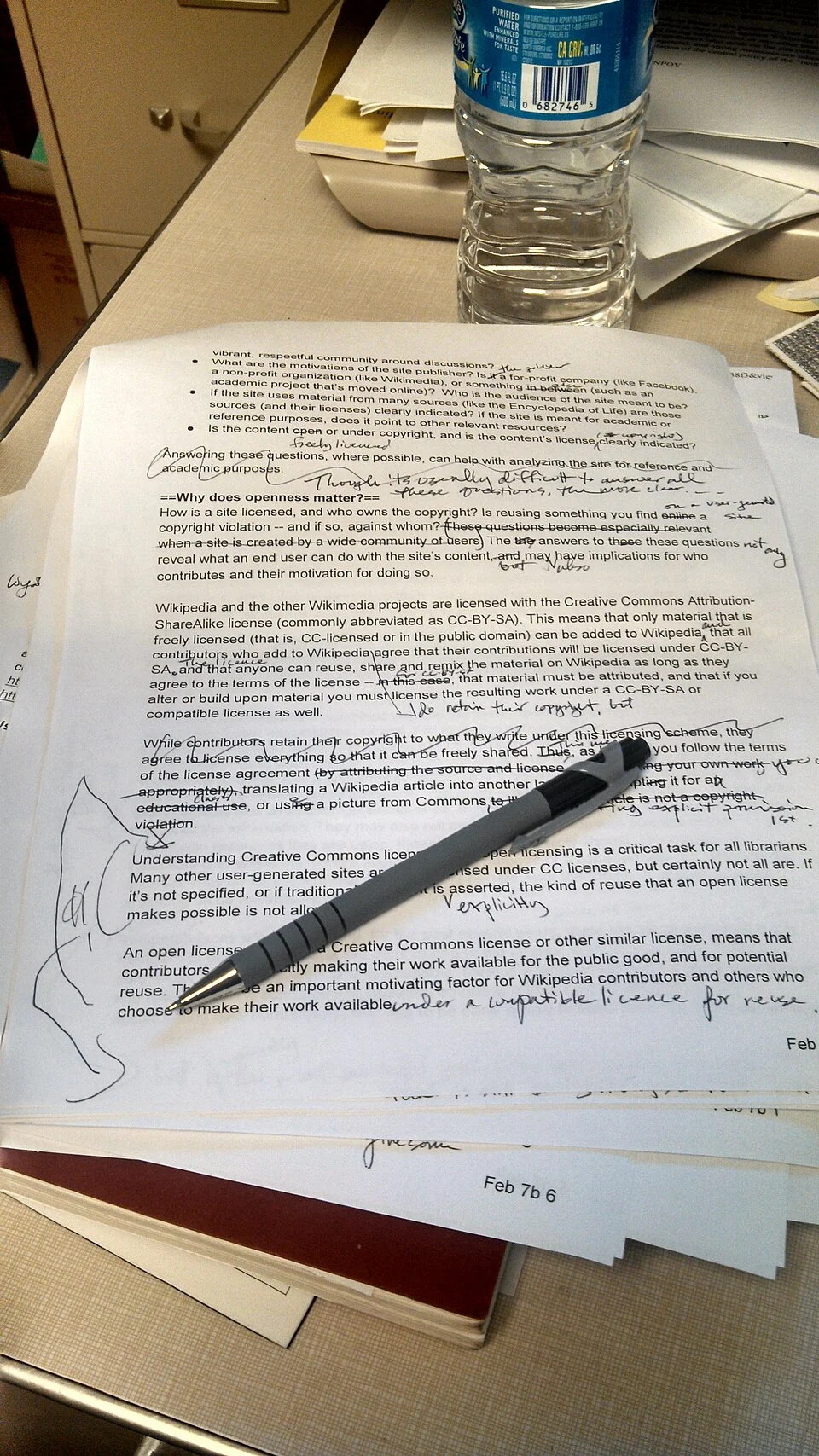
The cover photograph shows handwritten marks on a printed example. It is a depiction of revision in progress, not an illustration of one association's professional standards. A page crowded with marks can appear to be taking longer than a clean one, but it may not show the questions considered before the marks were made. One unmarked line can result from careful checking. A visible correction can be straightforward. Both belong to work for which a word count is only an initial measure.
Return to the fictional manuscript. A reader can check the multiplication and know the quoted amount under the stated conditions. What makes the price meaningful is the answer to a second question: what will the returned manuscript contain that it does not contain now? The agreed scope can name edited text, queries and any accompanying record. The count tells a person how much material passed into the job. A clearly described return tells them what they purchased.