The Quarter Hour on a Power Bill
Two businesses can use an equal amount of electricity and pay different bills. The difference can start with the shortest, busiest piece of their month.
In this story 4 sections
On the afternoon the freezer came on, the second oven was already warming. Nothing seemed unusual at the time. The business could make the same number of batches that week whether those tasks happened together or were separated by an hour. When someone studies the electricity records after the month ends, that brief overlap might turn out to have a price of its own. It depends on the rate used to write the bill and on what else the meter measured during the billing period.
A common description of an electric bill is “the price per kilowatt-hour times the kilowatt-hours used.” That is a sensible account of an energy charge under a flat unit rate. Some commercial bills have another line related to demand. Electricity reaches the site while machines are on, and the demand charge can be tied to how quickly a site took energy during a particular measured interval. The monthly total does not by itself tell you how much went through the meter at that point. A few busy runs make this abstract idea easier to see.
What was used, and how fast
A kilowatt is a unit of power, a rate at which energy is transferred. A kilowatt-hour is a unit of energy. Hold a rate of four kilowatts for an hour and the activity uses four kilowatt-hours. Take the same energy in a quarter of an hour and the average power over that shorter period is sixteen kilowatts. Both activities can account for the same energy in a bill. One asks for it at four times the average rate while it operates. Mistaking a kilowatt for a kilowatt-hour is much like mistaking a speed for a distance; there is a time interval missing between them.
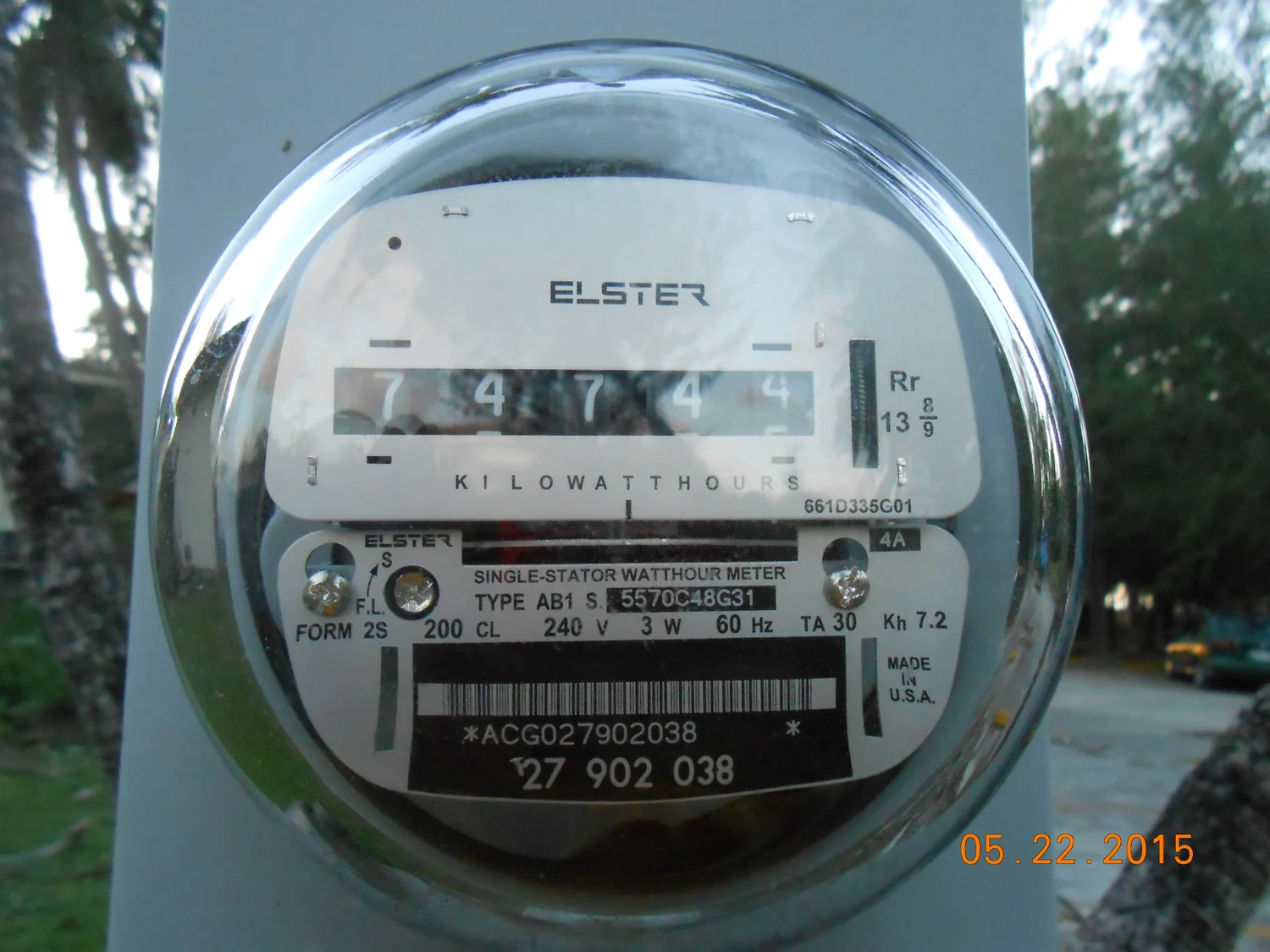
An electricity meter does not need to show a customer those two quantities on the same face. Monitoring software or the utility might offer interval readings separately. If you have a sequence of readings, begin by identifying what the column measures. A row with a reading of twelve could refer to twelve kilowatt-hours during an interval, twelve kilowatts of average load, or a cumulative register value from which a difference still needs to be calculated. A date and time next to it will not automatically identify which. The bill or manual should indicate the units and lengths of intervals used for the specific purpose.
In a simple example, a billing method uses the greatest average load within any of its defined fifteen-minute intervals in the month. For a given one of those windows, use the energy taken during the interval and divide it by one quarter of an hour to find average power. Four kilowatt-hours during that interval would mean sixteen kilowatts of average power. Utility arrangements vary, including the duration of the window, whether it is drawn from fixed slices or a moving measurement, which hours are counted, and how a billing quantity is derived from a measured one. A fifteen-minute example works well for the arithmetic. It is not a claim that every meter has to use that interval.
A pair of fictional bills
Take two small shops with made-up commercial rates and measured loads. Each uses 1,600 kilowatt-hours in a month. Each has a basic fixed bill line of $20 and a flat energy charge of 12 cents per kilowatt-hour. That part comes to $192 for either shop; add the fixed charge and each owes $212 on those two lines. We will ignore taxes and other adjustments in this invented example. Up to here the shopkeepers are looking at exactly the same numbers.
The first shop’s highest eligible average load is 12 kilowatts. The second shop’s is 20 kilowatts. The fictional utility charges $9 for each kilowatt of demand determined under its rules. The demand lines are $108 and $180 respectively. Add those lines and the totals become $320 and $392, separated by $72 even though the shops used identical amounts of energy. If the rate had only the fixed and energy lines, that $72 difference would not arise under the same assumptions. The comparison has to start with the stated terms. It takes more than knowing that one shop has a bigger machine.
Both owners might divide their bill total by their monthly use to put a number next to a kitchen budget. It gives effective average prices of 20 and 24.5 cents per kilowatt-hour in this example. Useful as a summary, the calculated averages do not tell them what one more kilowatt-hour will cost if it comes at the busiest moment. Another unit consumed in a quiet window could add only the energy price. Extra use in an interval that sets a new measured peak could also change the demand line. Converting the full bill to one average washes out that distinction.
Compare these accounts month by month before attributing the difference to a piece of equipment. If one total rose after a rate change applied halfway through the period, the two bills might carry different prices for otherwise comparable measurements. Keep the tariff date next to the meter date.
A little experiment with a schedule
Consider a fictional back room with a steady load of six kilowatts. Two pieces of equipment each use an extra eight kilowatts while running. Assume each stays on for a full measuring interval once and is otherwise off, and take those intervals as the ones the utility would measure. If both machines run at the same time, the combined load during that interval is 22 kilowatts. If they run in different intervals, the load in each is 14 kilowatts. In both cases the machines add four kilowatt-hours in total across their runs. The overlap, under the stated assumptions, changes load without changing the energy that the two machines add to the day.
That is not quite an estimate of what a change would save. Suppose an unrelated episode elsewhere in the same billing month already registered 23 kilowatts under the relevant method. The rescheduled runs would be below it either way. They would have to be the binding episode, or part of a program to change several episodes, to matter to a charge based on the monthly maximum. Some methods are more complex: a tariff might be based on load during a utility’s broader system peak or preserve a billing minimum based on previously measured demand. Department of Energy guidance discusses these as distinct arrangements. A new time on a whiteboard will not produce one universal change in a bill.
There can also be costs to moving work. Separating two batches could extend a shift, disrupt a pickup or leave equipment warm for longer. In that situation energy use might change as well, so the clean example of equal energy would no longer describe the operation. Assigning two jobs separate intervals offers a clear experiment on paper. Before copying its evidence to a real schedule, check what else has to be done when the change happens. The realistic comparison may be between two complete days of work rather than between the on and off times of two pieces of equipment.
Which readings would make a useful record
Take the names of all the charge lines from a bill and look for the rate description that goes with them. Record the units before adding comments. Mark whether the charge is fixed in a billing period, tied to energy, or tied to some measure of demand. A complicated bill can have more than one line in any of these groups. When several accounts are compared, keep the meter identifiers and reading periods distinct. Even businesses at the same address may not have a tidy single series if the measurements come from different equipment or contracts.
If interval records are available, choose a few high periods and try to match them with the actual schedule. A calendar that shows when work began may be more useful than a list of what was plugged in. Keep a record of unusual events, such as the testing of equipment after repair, without assuming those account for every similar reading. Note the interval’s time convention: a time printed at its end can be mistaken for its beginning. A half-hour discrepancy between two clocks can turn a plausible account of what happened into a false attribution.
Ask how often the load approached the apparent peak. A site with two or three isolated events can consider different operational questions from a site where many readings cluster in a narrow band during ordinary business. The second might have much less room to alter the charge by addressing one equipment overlap. If the utility only provides aggregate totals, find out what detail exists before deciding the business needs to collect independent measurements. The rate schedule and the available meter data determine how far you can go with the accounting.
The afternoon with the oven may ultimately be unexceptional. Another event could set the demand figure; the account could use a rate that does not include such a charge at all. It remains an instructive way to read the bill. Put the month’s use beside the most concentrated use identified by the rate, and keep each in its own units. One has a place for every batch. The other can preserve the short part of a day when several things happened at once.