When a Print Run Pays for Its Plates
Most of the front-end work on an offset press goes into getting the first acceptable sheet. A buyer comparing print runs has to ask what can be shared and what starts over with every version.
In this story 5 sections
Jump to the point in a printing job when the first acceptable sheet comes off the press. Its colours are in position, the image looks as agreed and the operator can refer to it while the rest of the stack is made. If the customer asked for a thousand copies, this achievement contributes one sheet, or perhaps no delivered copy at all if it is kept for reference. A great deal of work has already happened. The next sheet can follow much more quickly. For anyone comparing two prices, this gap between getting the first good one and getting one more is the place to begin.
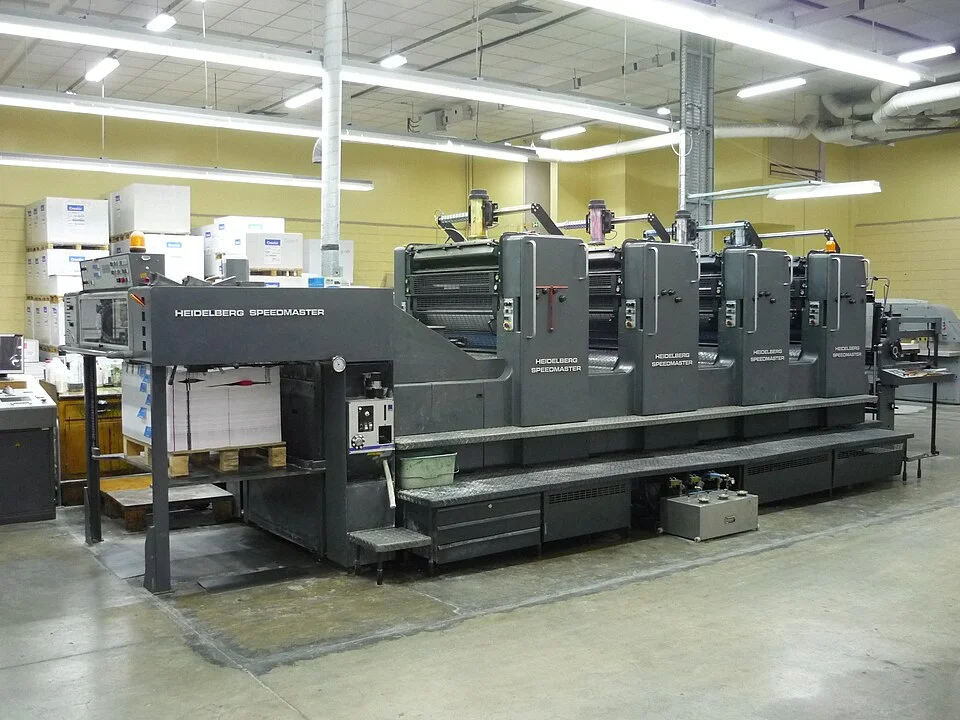
Rémih’s photograph shows a Heidelberg machine at the French national geographic institute during an open day in Saint-Mandé. The long press gives a scale to the objects involved. The picture does not establish the price of printing maps there. It illustrates how much space the production part of the work can occupy. A buyer comparing estimates is more likely to encounter imprecise words like set-up and per copy than to walk along the press in person. Each term deserves enough explanation to reveal why the total price responds the way it does to a change in quantity.
Work turns a submitted file into a printed sheet
A designer can send a PDF with a cover, several panels and a list of colours. The press needs arrangements appropriate to the equipment and to the size of paper it will run. Pieces that readers eventually see on separate pages may share a large sheet in production. The shop must lay them out so that trimming, folding or binding leaves them in the intended places. It also has to check for issues such as print that reaches the edges or content left too close to a fold. A file that looks good as a sequence on a monitor can still require preparation before it can be placed on a sheet.
In sheet-fed offset printing, prepared plates supply images for the relevant printing units. Ink from the plate transfers to a blanket and from there to the paper. A four-colour job commonly has separate image information for the component process inks. Two sides, different layouts or an additional specified ink can change the preparations. The exact plate count depends on the way a particular job is arranged, not merely on the count of pages supplied by the designer.
Preparing a plate doesn't complete the colour work. On press, the images from different units have to align, while the feel and appearance of the ink on paper have to suit the job. A production guide from press manufacturer HEIDELBERG gives examples of automated plate changing and controls used to handle such work. Automation changes the time involved and can reduce the number of sheets needed in preparation. It does not eliminate the distinction between work done to start the run and work that repeats as usable copies are made.
Count a stack in signatures, sheets or delivered copies
Say an association wants five hundred copies of a brochure. The shop may be able to fit two brochures' worth of a given piece onto one large sheet, or it may need several different sheets per copy. A count of sheets that passed through the machine is therefore not a count of brochures received. Think of a folded leaflet: two pieces might share a press sheet, be separated and then folded. A proof, an offcut or a sheet used in adjustment does not represent two completed leaflets ready to go to the association.
The difference also matters after the press slows down. Cutting and folding equipment can take time to set up. A binding operation may need another setup and can impose its own limits on the paper or layout. Packing the brochures in several labelled groups is another request. The press has finished by then, but the job has not. An estimate that says five hundred usable copies trimmed and folded answers a different question from one for five hundred impressions delivered as flat sheets. Compare prices for the state in which the material is actually needed.
In addition to the finished quantity, find out what will happen to a surplus or shortfall. The shop plans for paper used during setup and copies that may not pass inspection. Demand may be uncertain at the same time. A customer who needs at least five hundred good copies to fill five hundred envelopes has a different problem from a customer who can take whatever number between four hundred and five hundred will be economical. State the usable requirement while it is still possible for the shop to choose how to arrange the run.
Two quotes can trade places without either being unreasonable
Use a fictional comparison, with amounts in abstract units rather than actual market rates. One quote is 450 units to prepare a job and 0.18 for each delivered copy. Another is 50 to prepare the same deliverables and 0.58 per copy. At six hundred copies the first costs 558, the second 398. At sixteen hundred they come to 738 and 978. At one thousand the two totals are equal at 630. In this illustration, the cheaper process depends on how many copies are useful. It is neither everywhere nor nowhere cheaper.
That example assumes the comparisons cover the same paper, colour, size and finishing, and that each quote can be treated as a simple starting amount plus a cost per copy. Real price curves need not be straight. Suppliers may sell stock in packs, the shop may need a different paper to run a different machine, or one supplier may include a delivery the other itemizes. A cost can jump because all the copies now have to fit into another box, or because an order needs a second trip. The arithmetic is a way to test the principle before bringing those details back into the comparison.
Digital print can offer a route to a short run without producing offset plates for it. It still uses equipment, file preparation, stock and labour. Some work may suit one process for reasons beyond the quote. Compare the samples and the practical limits for this particular order while there is still room to make a change. There is no run length at which every job changes category. A threshold calculated for one brochure is a statement about the two quotes and the requirements stated for that brochure.
A thousand copies of one version are not four lots of 250
Imagine an association with four branches. It orders brochures that agree on every point except an address and a small map. There may be an opportunity to use a common set of inside pages and change something on the cover or a particular panel. If the versions instead need a different press form throughout, the operator may have to repeat some of the front-end work. It depends where the change occurs, how the press sheet is laid out and how the different versions are kept identifiable through finishing. Adding up the final stacks does not settle how many separate setups the shop had to make.
This is why questions about changes are useful before artwork is finished. A client might decide to leave a common brochure alone and supply a separate contact slip for each branch. A different client may need a fully integrated design and be willing to pay for the production work that creates it. The extra slip also takes time to produce and insert. The point of asking early is to let the alternatives be compared on the work they require instead of expecting design and production to have solved the same problem by coincidence.
Another decision concerns proof approval. If the plate is already prepared and someone notices a changed address, the new plate and a change to the production schedule can be real additional costs. Get the broad look right, but also review the small things likely to matter to the person receiving the final piece: dates, names, relevant numbers and the appearance of elements near a fold. A correction in a file can look trivial from one desk. It is more expensive if the same piece of work has already passed through the next two desks.
The most useful proof may expose a problem other than colour. If the brochure is going into a sleeve or being mailed, a folded sample at actual size can reveal an awkward fit. Fixing the dimensions can change how many pieces fit on the press sheet, so it belongs before the final quantity and price are assumed to be firm. A proof on a screen is good at displaying the address clearly. It cannot demonstrate that the object will fit into a customer's own envelope.
Keep the first good sheet in mind
The buyer looking at two quotations can ask which costs are committed before a usable copy is produced, how many versions there really are, and which condition the delivered pieces need to be in. Those three questions explain more about the shape of a price than an average from an unrelated job. They also make the promised date easier to discuss. A run that takes little press time may still need earlier approval and later finishing before it can leave.
There is a reason to keep a precise sample and a description of the approved job. If the association asks for more later, a record can clarify which setup can be reused and which must be done fresh. The first good sheet might look like all the later sheets. In terms of work already committed and choices still open, it is unlike any of them.