When a Carpet Roll Leaves a Remnant
A floor is measured in area, while broadloom arrives at a fixed width. A cutting plan determines the difference between how much a buyer orders and how much actually covers the floor.
In this story 6 sections
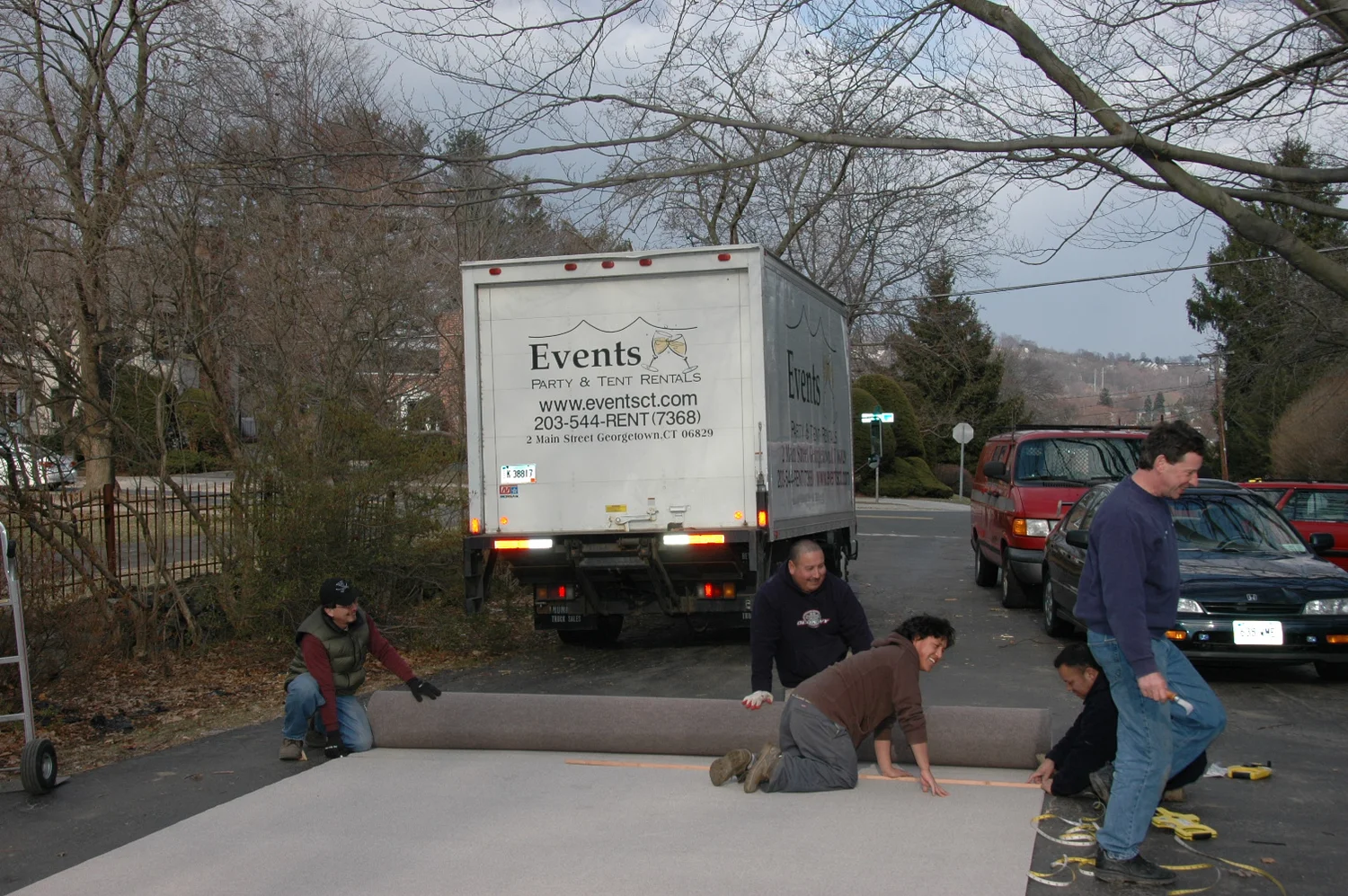
Don Williams’s photograph of a crew preparing carpet for a large event tent shows people occupied with a shape that will not keep the form in which it arrived. In the finished space the flooring is supposed to meet boundaries already set by the tent. The material has to be placed and cut to meet them. A retailer’s roll offers a different boundary, a fixed distance across it and a length of material that can be drawn off. The gap between those two shapes is where some of a buyer's price and some of a seller's inventory are decided.
The photograph does not document any particular material calculation for a home. The event crew's task is useful because it makes the economic issue visible: material is supplied in one shape and purchased for a different one. A floor plan can tell an owner what area needs covering. That area does not say which pieces will share a seam, how much of a repeating pattern needs to line up or whether the part left on the roll is wide enough for the next job. A price comparison that treats all areas as interchangeable can be exact about the wrong quantity.
A square metre is an area, not a piece
Imagine a rectangular floor 3.6 metres wide and 4.8 metres long. Its area is 17.28 square metres. Now imagine a roll four metres wide. Ignore allowances for fitting in this first geometric example. Unroll 4.8 metres and the supplied area is 19.2 square metres. The floor fits inside that piece. There is an excess strip four tenths of a metre wide running the length of the piece, with an area of 1.92 square metres. Subtracting the two areas tells how much material is left, but it does not tell you what can be made out of it. A square of roughly that same area would be a different object in the hands of the customer.
Rotating a plan can change which dimension the roll width meets. Take a second room that measures 4.2 by 3 metres. It cannot be covered in one piece set so the four-metre width faces the 4.2-metre dimension. With the three-metre dimension placed across the roll, a length of at least 4.2 metres can encompass the rectangle before any allowance. There is no change in the room's area. There is a change in which way the floor fits on the available supply. The proposed shift may be ruled out by other considerations, such as the appearance of an adjoining floor or the placement of a visible pattern.
These examples make a distinction worth preserving on a quote. Floor area describes the space measured. Order quantity describes a cut that can accommodate the space in an agreed arrangement. When a store quotes by length on a roll of known width, the two values may even use different units. Converting them to the same units helps a person compare costs, but only a plan can explain why they are different in the first place.
A doorway can use more than its measured area
Consider a room with a shallow recess near one wall. If the recess is included in a continuous piece, the length or width of the supply may have to accommodate the farthest extension even though most of that band is trimmed away. A seam at a suitable place might change the options. Someone reviewing prices can ask where the seam is proposed and which pieces belong to it. The answer helps assess whether a smaller purchase works for the room and for what the buyer expects to see there.
Patterns bring another constraint. A stripe may run down a room or across it. A repeating figure chosen for noticeable alignment can require spare length so the next piece starts at the right place in the repeat. Two pieces cut to lengths that cover a shape exactly can still fail to meet it visually if they leave the pattern out of step. The Carpet and Rug Institute standards discuss layout and seaming conditions. For a buyer the point is to ask which way the plan puts the material and what the price assumes about appearance, rather than treating the pattern as a surcharge with no physical explanation.
One should distinguish direction from quantity. A rectangle will still fit geometrically after a quarter turn if both sides are within the corresponding dimensions. A carpet with an obvious direction will look different when turned. Even an apparently plain surface can show a different tone with the light if its pile is oriented differently. A buyer comparing two pieces should confirm whether a change needed to save material would produce a visible result they do not want. Some sizes are possible on a cutting diagram and poor choices for the space that will be used.
An offcut and the remainder on a roll are not the same thing
Using the first imaginary room, there is a narrow strip left after the cut piece is fitted. The seller could still have a length of untouched material behind the part that was bought. The two remainders belong to different places in the process. The first was included in the supplied cut and could remain with the customer or be dealt with as agreed. The second is inventory that may be sold into another plan. A question about whether the price includes the offcut gets a more useful answer if it says which of those two things is meant.
A remnant can be worthwhile to sell if it is large and suitably shaped for a different job. The buyer of a rectangle needs the dimensions of that rectangle in the material. An offer for a remnant described only by area may be a poor basis for deciding. Its shortest relevant dimension and any irregular sections matter. The surface condition can matter as much as the price. An economical piece is one the proposed cut can live inside. It is not every leftover whose area is at least the same as the floor.
Shops have decisions to make about measuring, marking and storing those pieces. A long roll of a known product can be easier to catalog than several irregular cuts with different possible uses. Offering the latter to customers takes room and time, but a workable offcut can lower the cost of an appropriately sized job. A seller who records dimensions and direction gives a customer useful information before anybody has to move a heavy piece out to inspect it.
A second room can use the way the first one fits
Suppose two small, imaginary rooms can be covered by single rectangles 1.8 and 1.7 metres wide. If both need a length of 3.4 metres and could use the same carpet in the same direction, their widths add to 3.5 metres. With no fitting allowances in this simplified example, both could be cut side by side from a four-metre roll in one 3.4-metre length. Reaching that conclusion by adding the rooms' square metres would miss what makes it possible: a workable arrangement across the width.
If one needs a different pattern or a piece taken in another direction, the figures on that drawing may stop being useful. A seller can compare the combined plan with buying the pieces separately. It is the fact that the useful pieces can be placed together, rather than the mere presence of two rooms on the order, that offers a saving.
Keep installation and supply on the same page
A fitting quote may include time to make seams and deal with furniture, the previous floor covering or a cushion underneath. Those items are not implied by a price for the next length cut from a roll. The Carpet and Rug Institute suggests confirming what workers and the owner will do around the installation. This matters even where pieces can be planned on one sheet of paper. A remnant sold without extra services and the same remnant fit into a prepared room are different transactions.
A plan can also show the cost of a last-minute change. Perhaps a small adjoining section was left outside the earlier estimate, and adding it means a separate piece or moving a seam. The floor area increases by a little. The preparation and purchase might increase by more. Someone paying for the work should ask how the change fits into the layout they already agreed to. A comparison between one added price and the cost of a square metre taken from an unrelated line of carpet will not answer that question.
Ask to see the piece in the plan
The crew in the photo has a span of carpet visible before the floor shape is established. A customer can get the same kind of perspective from a cutting plan without being there when it is unrolled. The plan need only show useful dimensions, the way the pieces face and where cuts or joins are expected. It can leave room for adjustments after a site measurement. What makes it useful is that it lets a buyer distinguish a sound allowance from a piece omitted by accident.
A floor can be measured as one total. A roll becomes useful when that total can be fitted to an actual length, width and arrangement. After the cut, a smaller piece may have a different use, or no practical one for this order. The price makes more sense once someone can point to that piece and say where it came from.