What a Laundromat Sells by the Load
The price on a washer buys a cycle in a machine of a particular size. Heating, repairs, drying and the hours nobody comes are part of the business calculation.
In this story 6 sections
The first price you see in a laundromat may be stuck to a door that has nothing behind it. Put in some laundry and the object for sale becomes clear. For one cycle you get the use of a drum of a certain size, hot or cold water according to the program and the motion of a machine other people can use after you. There is nothing much to carry out of the shop except what you brought in. The service is the change made to it during a small interval of time.
This is quite a specific unit to price. A customer with a single large blanket and a customer with a bag of shirts may not need the same machine, even if the weight of their laundry is close. The owner has to choose how many machines of each capacity to provide before either customer arrives. The price printed on the glass, the length of the cycle and the mix of empty drums meet at the point where the customer decides what can be washed together.
Four dollars does not usually describe a whole visit
Imagine a fictional shop with a four dollar wash in a small machine and a six dollar wash in a larger one. A visitor has two modest piles of clothing that can be washed together. If they fit and the combined fabric is suitable for the same program, one six dollar load could be less expensive than two four dollar loads. If the piles need separate treatment, the comparison changes. Capacity creates an option, but it does not remove the decisions about what may share it.
There may be a charge for drying, additional time or an optional purchase such as detergent. In our example, suppose drying is billed in one dollar blocks of ten minutes. A person who expects to need three blocks might compare a complete visit costing nine dollars for the large wash and drying with another visit that uses the same drying time and two small washes for eleven. If more drying time is required, that changes both totals. These are illustrative prices, not a claim about the cost at the laundromat in the photograph.
Time can also be purchased separately from capacity. Another customer might choose two machines side by side rather than running two cycles in one drum. The cost is higher than sharing a compatible large load under these assumptions, but the waiting is different. Conversely, a person who already planned to dry clothes at home need not treat the drying tariff as part of the decision. Comparing a row of price stickers makes sense only after you decide which of the possible services you actually need.
The owner pays some costs for a cycle and others for the room
Water, heating and electricity are closely connected to running equipment. A cycle uses them in proportions that depend on the machine and the chosen program. Rent behaves differently over an ordinary month. It is due if very few people come on Wednesday as well as when a Saturday is busy. The business can recover that cost through its total receipts, but the next wash does not generally cause another full payment for the room.
It is tempting to calculate a cost per load by dividing one monthly expense by the number of loads and treating the answer as a property of the machine. Suppose the fictional shop allocates 1,200 dollars in monthly rent to the calculation and does 600 washes. That allocation would put two dollars of rent against each wash. At 800 washes it would put 1.50 dollars against each, even if the rent and machine are unchanged. The exercise is an allocation rather than a claim that one wash consumed two dollars of floor space.
A record intended to help with pricing should acknowledge shared uses of the room. A dryer, a folding table and an area to wait all occupy part of the space. One cost might be allocated across both washing and drying revenue for a particular comparison. That is a reasonable choice if it is made visible. A business can get quite different looking margins by moving the same rent from one service to another without making any change in its cash position. The assumptions belong alongside the arithmetic.
A minute in the drum is not always a minute available to sell
Suppose a washer's selected cycle lasts thirty minutes. Two cycles can fit in an hour only if someone is ready to clear the first load as soon as the cycle ends, start the second with little delay, and avoid any time spent cleaning or taking the machine out of use. The theoretical number of starts says something about capacity. It does not settle how many starts a shop can expect to complete in a real hour.
It helps to count idle time in more than one category. A machine might be empty because nobody is waiting. It might be out of service. It might be holding a finished load until the customer comes back to move it. All three can appear between paid starts on a report. They call for different responses. Changing the price of an empty drum during a slow morning does nothing to repair a broken machine. An update that reminds customers about a finished cycle might be useful only where delayed pickup is already a problem.
During a queue it can matter which machine is free, not simply whether there is one. A spare small washer does not answer a demand for a single drum big enough for a bulky item. Counting all machines as identical will overstate availability in this situation. Record which size draws the longest waits and when. That can help the operator distinguish overall lack of capacity from the selection on the floor.
Compare equipment at the unit you plan to sell
ENERGY STAR provides information about commercial clothes washers and explains metrics for comparing water or energy use with capacity taken into account. A capacity-adjusted figure is useful because one of the purposes of comparing machines is to understand whether they can do different amounts of work. It is not a number from which to infer a particular shop's utility bill. Program choices, number of cycles, local rates and how the equipment is used all matter.
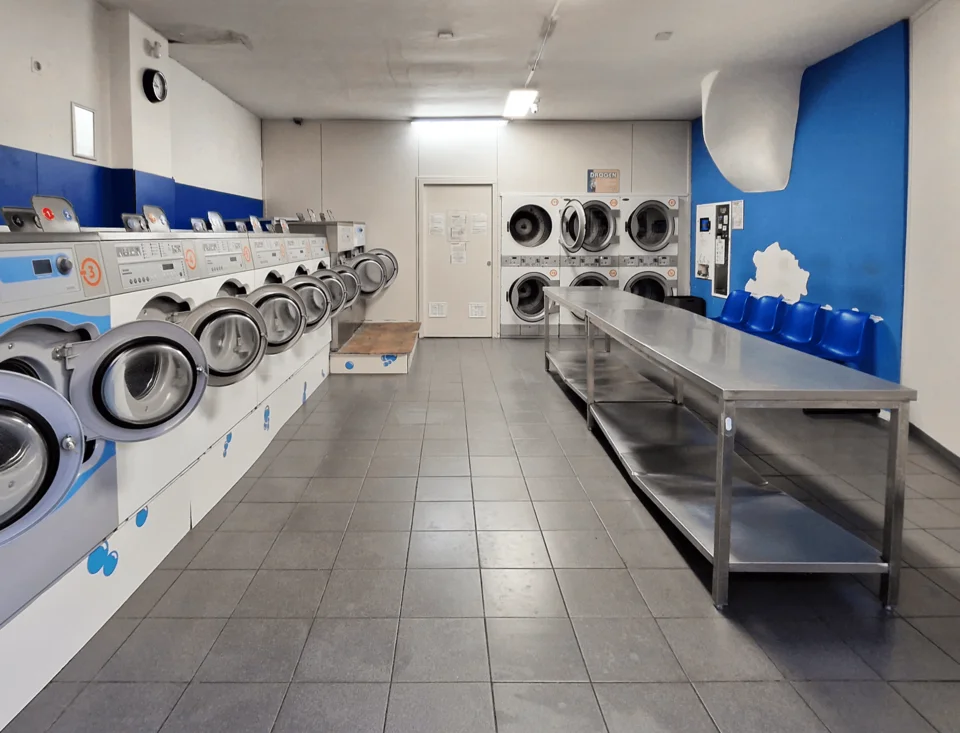
For example, an operator might compare two machines for a site with many small loads in the morning and a rush for larger drums later. A water figure tells one part of the story, provided the tested capacity and basis are understood. The machine price, maintenance arrangements, time out of use and practical range of customers are also relevant. In the photograph from Breda, the visible row of equipment and the folding area capture two ingredients of the service. Neither the size of the line nor the neatness of the furniture is evidence of the shop's costs.
After the wash, a dryer is a separate use of time, equipment and energy. There can be a mismatch between the number of customers finishing a wash and the number of conveniently available dryers. A machine-room plan made only from average demand can overlook that local pattern. A count of the busiest two or three changeovers can give a clearer question to investigate than a total for the day.
A repair can change the service without changing the tariff
Suppose one of two large washers in the example is shut for repair. Small machines are still available, so the posted range of prices may look as it did the day before. Yet the person with a bulky load may have only half as many usable drums to choose from. Counting all idle machines would hide the consequence. A note at the entrance or on a service listing can tell someone which size is temporarily missing before they empty their bag in the aisle.
For the operator, the reason to track this interruption is not just to predict the day's takings. How long a machine is unavailable depends in part on whether faults are noticed quickly, what service the supplier offers and where parts are stocked. Two washers with similar power consumption can create quite different business costs if one spends longer awaiting service. A purchase comparison becomes more useful when it includes the cost of the kinds of interruption customers can actually see.
What to put where people make the choice
A helpful price board says what starts the cycle and what costs extra. If drying is priced by time, list the time block rather than just its price. If the available washers differ in size, label the sizes on the machines and on the board using the same names. A customer should not have to guess whether a machine called large in one place is the one priced as double somewhere else. A small mismatch can turn into a complaint even though each isolated label is technically readable.
Keeping cycle and capacity information together helps a shopper who wants to make the comparison without holding up the queue. It also gives the owner a better way to explain a rejected transaction or a different choice. From across a room the business can look like a line of doorways waiting to be opened. At the point of payment each doorway offers something more exact: use of a particular machine, with a particular amount of room, through a specified program. That is the unit both sides need to be able to recognise.