When Twenty Loaves Share a Bake
The cost of fitting an extra loaf into a tray is small beside the cost of starting another load. An oven schedule shows where the difference comes from and what happens when the bread is not ready at the right time.
In this story 5 sections
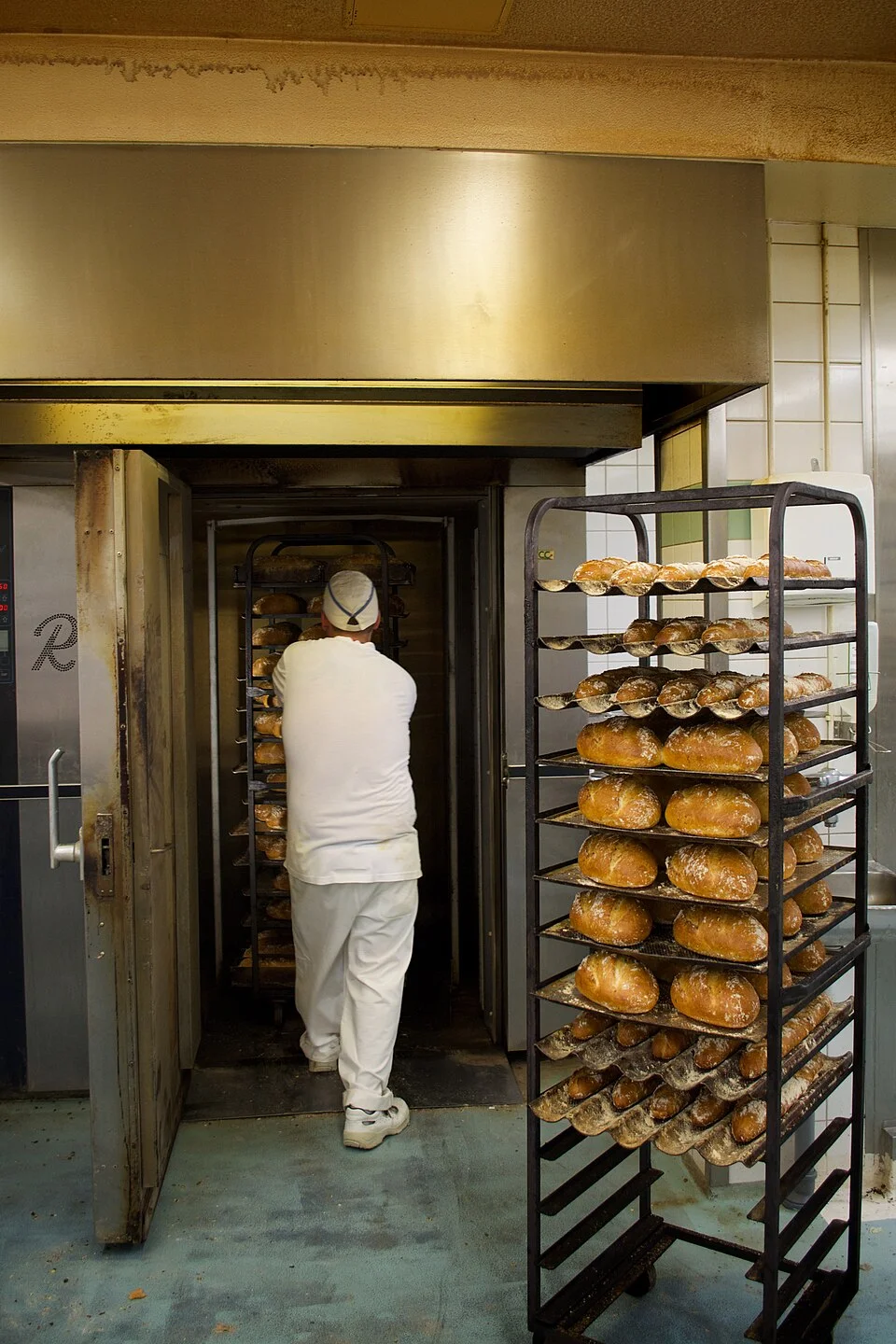
A tall rack of bread waits beside the oven in Jarkko Laine’s photograph of a bakery in Helsinki. Trays occupy different heights and loaves take up a portion of each tray. The photograph makes the size of the oven easy to see without showing its schedule. A person looking at it might reasonably ask how many more pieces could fit. A baker also needs to ask which pieces would be ready for the same load and how soon the next load could follow. This second version of the question has very little to do with the width of an empty shelf.
Suppose a small bakery is choosing whether to take an order for several more loaves. If it already has room for them in a compatible bake, the additional work can be quite modest. If the existing load is full, the same order can use a separate stretch of oven time along with more preparation and handling. The first economic task is to discover which case the business is facing. A per-loaf average taken over the previous month cannot identify the point where extra bread begins to need extra time.
Give a load a definition before counting it
Imagine that a baker can comfortably fit twenty of one type of loaf into a load arranged for that product. Use that number for the example, rather than assuming it describes any real oven in the photograph. A load of sixteen leaves room for four in the same bake if they can be handled with the others and meet the same conditions. A load of twenty-four cannot simply be declared the same job. There is still the original rack to fill, followed by a place to put the other four. The time from adding four to a load of sixteen is not a good guide to the time from adding four to a load of twenty.
It is worth distinguishing between space that can physically accept a piece and space useful for producing an even result. Pieces may need a certain amount of separation, and a particular mix of sizes may be hard to handle together. A shelf that can take another pan may be awkward to reach during the expected handling. Some kinds of bread need different conditions or finishing times and cannot share the bake just by fitting inside the same door. The workable capacity belongs to a particular arrangement of loaves and conditions, rather than to the empty volume quoted for a machine.
The promised unit is also worth checking. A tray of small pieces and a row of long loaves could be similar as a weight of dough but very different to place and handle. A count written for one family of products is not sufficient to plan an unfamiliar one. A useful schedule describes which product the limit refers to and which other ones can reasonably share the interval.
The oven was doing some work before the door opened
A bakery may need to bring the oven to its operating condition before the first load, keep it ready between loads and see how it behaves when the door is opened and cooler material is put inside. A particular loaf does not cause all of that energy use by itself. If the bakery opens the machine for a small number of items and then stops, relatively little saleable bread is available to carry the shared expense. A full load may still use more energy than a small one; it makes no sense to assume the meter will register exactly the same amount. The question is how much of the job required getting the oven ready regardless of the count.
Research on thermal energy in industrial bread production treats a bakery as a system with several activities. For the purposes of a small workshop, a similar way of accounting can separate what happens in the oven from what happens around it. An employee may spend time mixing, shaping and preparing a rack while another load bakes. Cooling and packing use working space once the oven has been emptied. If the oven sits warm without useful bread ready for it, the gap may belong in the investigation even though no one touched a switch.
Consider two schedules with identical orders. The first brings one set of dough ready for the oven as another is removed. The second leaves a long pause because the next dough needs more time before loading or someone is away preparing other work. The oven itself may bake each set in the same minutes. The second schedule requires more of the wider working day. A report stating bake time per load is informative but cannot locate that wider use of time.
There are times when an empty space should stay empty
Keeping the oven busy is one goal, but the bakery sells bread at times people want it. A small number leaving early might fill an order that cannot wait, even if a fuller load would save effort per piece. Loading every space could put bread on a rack where it has no planned buyer. The business can reasonably accept an empty part of one bake if the alternative is making stock whose value depends on demand it cannot yet see. The cost of empty capacity is one consideration, alongside the cost of finished material that sits longer than expected.
The reverse case also occurs. A compatible order accepted at short notice might occupy part of a load that would otherwise use the same rack, employee time and oven preparation. To judge it fairly, add the work and materials that really change. The answer may differ from an accounting figure distributing all of the first load's setup evenly across the pieces. Spreading costs is useful for knowing whether a business recovers them over time. It should not prevent the people planning one particular bake from asking which costs are already committed.
Imagine that the additional order must be cut, wrapped and delivered on its own. It may share baking time with the shop's other bread and still involve work at other stages. The answer “it fits in the oven” only settles the part of the quote that concerns oven space. Identify which stages can be shared, which have their own minimum use of time and when the last step needs to finish. Then the bakery can tell why adding something small to the production row may add something less small to the promise to a customer.
The queue begins in the dough room
The useful unit of planning may be the moment loaves finish being prepared, rather than the moment a finished load is supposed to leave the oven. Dough can be ready before a door opens for it or too late to follow without a gap. Putting a deadline on the final bake does not create time earlier in the day. Workers still need to fit preparation and handling into the places the production sequence allows. One busy kneading or shaping stage can leave the oven waiting in spite of a desk schedule showing a full day of bakes.
For a team planning two orders, write down what can happen while the first load is in the oven and what needs the same person or work surface at the same time. A task that fits on paper can become an obstacle if somebody has to prepare a rack and unload a bake at opposite ends of the room. The things pictured by the oven are part of a larger movement of trays, people and space. Adjusting one part of the sequence might free a slot without purchasing anything, or show that a constraint elsewhere would make a supposedly bigger oven of very little value.
It's useful to record when loads are actually put in, taken out and moved on. If a gap recurs at the same time, the pattern offers a better question than simply asking why the day takes so long. Does a particular bread take preparation away from the following one? Do trays stay in use while cooling? Is the extra time the result of the way orders arrive? The answer can change the next schedule without asking anyone to work faster than the process allows.
The twenty-first loaf has a different prospect
Look again at the rack beside the oven. Some racks are moving in and others are about to move away in a real bakery, though the photo freezes only one arrangement. What a small business buys with the available time is a sequence of workable loads. One more loaf may join a sequence smoothly or ask for another whole stage in it. The difference depends on readiness, conditions and timing, not on the retail fact that all the pieces can be counted one at a time.
A buyer asking for several extra loaves may usefully tell the baker when the last one is needed and whether the order can come in two parts. A baker considering the request can ask which part of the day already has a place for the work. Between the two there is a chance to settle a practical arrangement. A short question about the twenty-first loaf can reveal more about the trade than a perfectly calculated average for the first twenty.