Why a Coffee Roaster Weighs Twice
Green coffee is bought by weight and roasted coffee is sold by weight. Weigh both and a producer can estimate how many bags can actually be filled, and what each one needs to cover.
In this story 5 sections
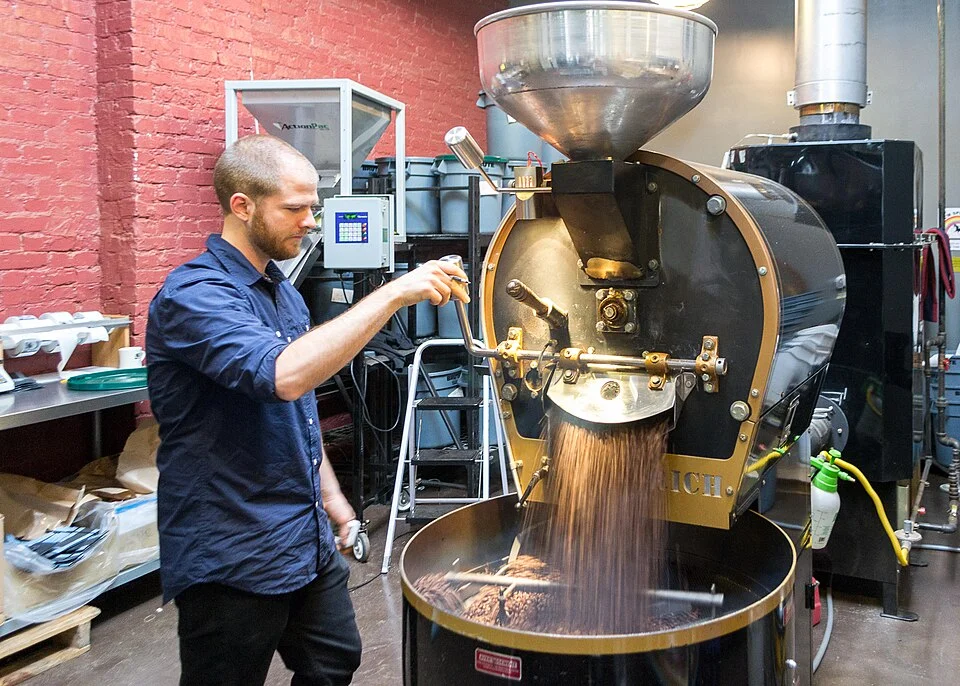
In Visitor7’s photograph, a stream of coffee falls through an opening in a roaster and into a round tray. A worker stands close to the machine as the batch comes out. The coffee entered the roaster at one weight and will be available to pack at a lower one. The original purchase order records how much the shop paid for. The amount in the tray helps tell the shop how much it actually has to sell.
The distinction is easy to miss from the side of the retail counter. A shopper picks up a packet of roasted beans and compares its weight with that of a second packet. They can see neither the amount of green coffee needed to make it nor the room the shop set aside for material it could not put into a packet at all. Following one batch from the first weigh-in to the finished order helps explain why a difference in yield can change a price or a schedule even when the supplier's cost per kilogram stays still.
What leaves when the beans get hot
The green and roasted beans are the same batch only in one sense. During heating they change physically and chemically. A study comparing several roast levels describes changes including loss of mass and the release of gases. Water leaves, and other volatile products can depart during roasting. There can also be light detached material to separate in ordinary production. The beans can occupy more space at lower density, so judging the amount by how full a container looks is a poor shortcut to the scale. None of this identifies what happened in the photographed batch specifically. It shows why in general a roast comes with a second meaningful measurement.
The separation between measuring and inferring is practical. A business can weigh what goes in and what comes out without doing a laboratory analysis of which fraction of the difference was water. A comparable record may be enough to find out that a kind of coffee or an intended roast consistently has a different yield from another. Initial moisture and the treatment in the roaster can vary. A rate worked out for a different raw material or finish may give a good first estimate and still be a poor figure on which to promise the last bag.
It helps to agree on the moment of measurement. Is the second weight what comes out of the roaster, what is available after cooling and sorting, or what gets packed after samples are taken? Give the positions their own names if the shop wants to track them all. A piece of paper beside the roaster does not have to look complicated. A date, lot, quantity in, quantity at a specified point out and reason for later deductions will do far more than a single number labelled batch weight.
The same care applies to containers. A reading with beans in a heavy tray cannot be compared directly with a reading of loose green beans in a small tub. The record has to reflect the contents, with the container weight accounted for consistently. Otherwise a change of tray can appear on paper as a change in what the roast produced, while nothing about the coffee itself changed.
Put two figures into one calculation
Consider an imaginary roast with ten kilograms of green coffee. Suppose the batch weighs 8.5 kilograms when the producer takes a consistent cooled-output reading. For this example the yield at that point is 85 per cent: divide the second weight by the first. The lost mass is 1.5 kilograms. If nothing else were deducted and precisely 250 grams went into each packet, that output would supply thirty-four packets. Counting the first ten kilograms instead would have suggested forty. The discrepancy is significant if the producer already promised thirty-eight.
Now change the record a little. Some coffee is removed for checks or samples and the producer has 8.3 kilograms to pack. That is enough for thirty-three full 250-gram portions with a small amount left in this arithmetic. It is a different category from the 1.5 kilograms lost during roasting. The samples still exist; they may help the shop decide a batch is suitable for sale. Plain language can keep the producer from confusing them with what went away during heating. It also helps if the person planning next week's purchase is not the one who handled the roaster.
The calculation should not suggest that every actual packet will contain exactly the named quantity to the last fraction of a gram, or that an uneven balance can be ignored. It just relates quantities at different stages. A company comparing expected output with its own recent runs can set aside enough for ordinary differences in production, checks and packing. The value of a reference number lies partly in knowing how far actual values tend to move around it.
The price of purchased beans gets spread over sellable weight
Suppose the ten-kilogram input cost eighty units of currency and that no further cost has yet been counted. That is eight units per kilogram purchased. If the cooled output is 8.5 kilograms, the raw coffee alone has contributed about 9.41 units to each output kilogram in the example. Before packing, the cost per finished kilogram can rise again if some material is used for checks or held aside. There is no problem with the supplier's price or the scale. The two prices refer to different things: the quantity paid for at one end and the quantity available to carry its cost at the other.
A producer could divide the total first cost among only the full packets. This would answer a useful cash question if the remaining portion had no sale or other use on that occasion. A company that carries a remainder into another permitted use might account for it differently. In either case, the conversion between input and output is only part of the total. There are still the hours of handling and roasting, energy, a container, a label, deliveries and perhaps costs associated with selling. The example doesn't tell a customer what a real bag should cost. It explains why dividing a green invoice by the retail label's weight omits part of the calculation.
A difference in yield can change the cost without changing other work much. Say two inputs of the same mass had the same purchased price, and their finished output weights differ. The lower-output batch needs to recover that purchase across fewer kilograms. Its actual selling price may reflect a choice about flavour and use that makes the difference worthwhile to the shop and customers. The arithmetic is informative without asking all coffees to share a single yield or a single price.
A batch is also an appointment with a machine
An extra few bags cannot always be made by scooping an extra amount of green coffee into the next batch. The machine and the intended process may suit a certain workable size. If the order goes beyond it, the roaster might have to make a second batch, with another pass through preparation, heating, cooling and checks. The total difference in purchased weight can be small compared with the change in time. That is why a producer concerned about filling only one more order may want a clear schedule as well as a more confident average yield.
The business also has to decide what can be done with output that doesn't immediately have a buyer. It might suit a steady shop demand or be a distinct product from the one customers expect later in the week. Taking on excess has a cost when the main purpose is to have coffee ready at a useful time, not simply to make a scale register a number. Too little output leaves requests unfilled. Too much output may shift effort into finding uses and deciding what should still be offered. Weighing does not solve demand, but it removes an avoidable quantity error from the question.
An operator taking on a large order can work backward. Start with the good weight the orders require. Identify the point in the process at which that weight has to be available. Then look at records for comparable coffee and use them to estimate how many workable runs will supply it. Record what was planned and how the actual number came out. Even an estimate that needs adjusting next time becomes more useful if it can be compared cleanly to what happened.
Listen to the two numbers separately
The producer in the photograph is at the stage between a batch that came through the roaster and something that will become usable sale stock after cooling and handling. One quantity was known before the coffee entered. A second has to be checked afterward. A third may answer how many packets actually went somewhere. For a shopper the packet on the shelf supplies all the quantity information needed for a comparison at that moment. For the business it is the end of a chain of quantities.
None of the earlier numbers has to be discarded once the next one is available. The purchase weight explains the initial cost. The cooled weight explains the result of processing in a form that can be compared across runs. The packed weight explains how much reached the intended use. Keep those figures distinct and a roaster can understand a modest shortfall without blaming a good scale, and can plan another batch without pretending the next bag already exists.