Why the Tub Is Not in the Price
A scale can show the weight of a container and its contents together. The price of an item sold by weight depends on separating the two.
In this story 5 sections
The tub at the deli counter looks empty before the clerk spoons in some olives. It is already doing work. It makes the portion easy to carry and gives the clerk somewhere to put its label. It also adds weight. If the posted price is for olives by weight, the counter has to find a number for the olives alone. Using the total weight in the tub would make the shopper pay the olive rate for some plastic.
That difference is no large mystery. It is the sort of calculation that passes unnoticed when the display moves quickly and the clerk reaches for the next lid. But for a tiny interval the scale is where two kinds of counting meet. The person behind the counter has to sell a portion. The person paying for it has to decide whether the portion costs what they expect. Both are better served when the numbers on the label describe what was actually weighed.
Three weights and a price
Take a fictional counter where olives cost twelve dollars per kilogram. An empty tub with its lid weighs twenty grams. The full container weighs three hundred and seventy grams. The portion is three hundred and fifty grams, or 0.350 kilograms. At the posted rate the olives cost 4.20 dollars before any separate tax or adjustment. Pricing the full weight instead would yield 4.44 dollars. The difference is twenty four cents. Notice that the amount would change if the same container held a product sold at a different rate.
Three words make the example easier to follow. The full assembly is the gross weight. The tub and lid are the tare. Subtracting the tare leaves the net weight, the amount of food in the container. If the product was priced by weight and the other assumptions in this example hold, that last number belongs in the multiplication that gives the item price. The person who asks for about four dollars' worth is really asking for two acts of translation: from dollars to a target weight and from the scale back to the final price.
The point is easiest to see by imagining two identical portions with different packaging. One leaves in twenty grams of plastic. The other goes into a sixty gram container. If both are priced by net weight, the cost of a given amount of olives at the posted rate is the same. If both are priced by gross weight, the second customer buys more expensive packaging at the same rate as the food. A documented separate charge for packaging, where applicable, is yet another thing. It need not be hidden inside the weight of the goods.
Two ways to subtract the tub
A person can put the empty container on the scale before filling it and set the instrument to take its weight into account. Imagine a display that returns to zero with the tub already sitting there. The load is not gone. Instead, the next indication can start from the product added to the tub. To use this workflow consistently, the counter needs to account for the same parts of the packaging that will be on the scale during the final measurement.
Another way is to use a known tare value that corresponds to the packaging. NIST describes stored tare in its discussion of weighing operations. In a counter with several sizes and materials, this makes it important to select the correct container type. Convenience depends on maintaining the choices introduced by the menu. Changing the supply of tubs, or adding a lid with a different weight, is a reason to check the stored value rather than assuming the item description still covers it.
Those procedures answer a different question from whether the weighing instrument is accurate. A properly functioning scale can produce an accurate gross reading from which the wrong amount is subtracted. Equally, using the correct kind of tub does not guarantee the instrument has started from the right baseline. Good counter practice keeps the steps separate. Clear item labels and a repeatable routine make it easier to see which part of the sequence needs a closer look.
What the scale at the produce display can tell you
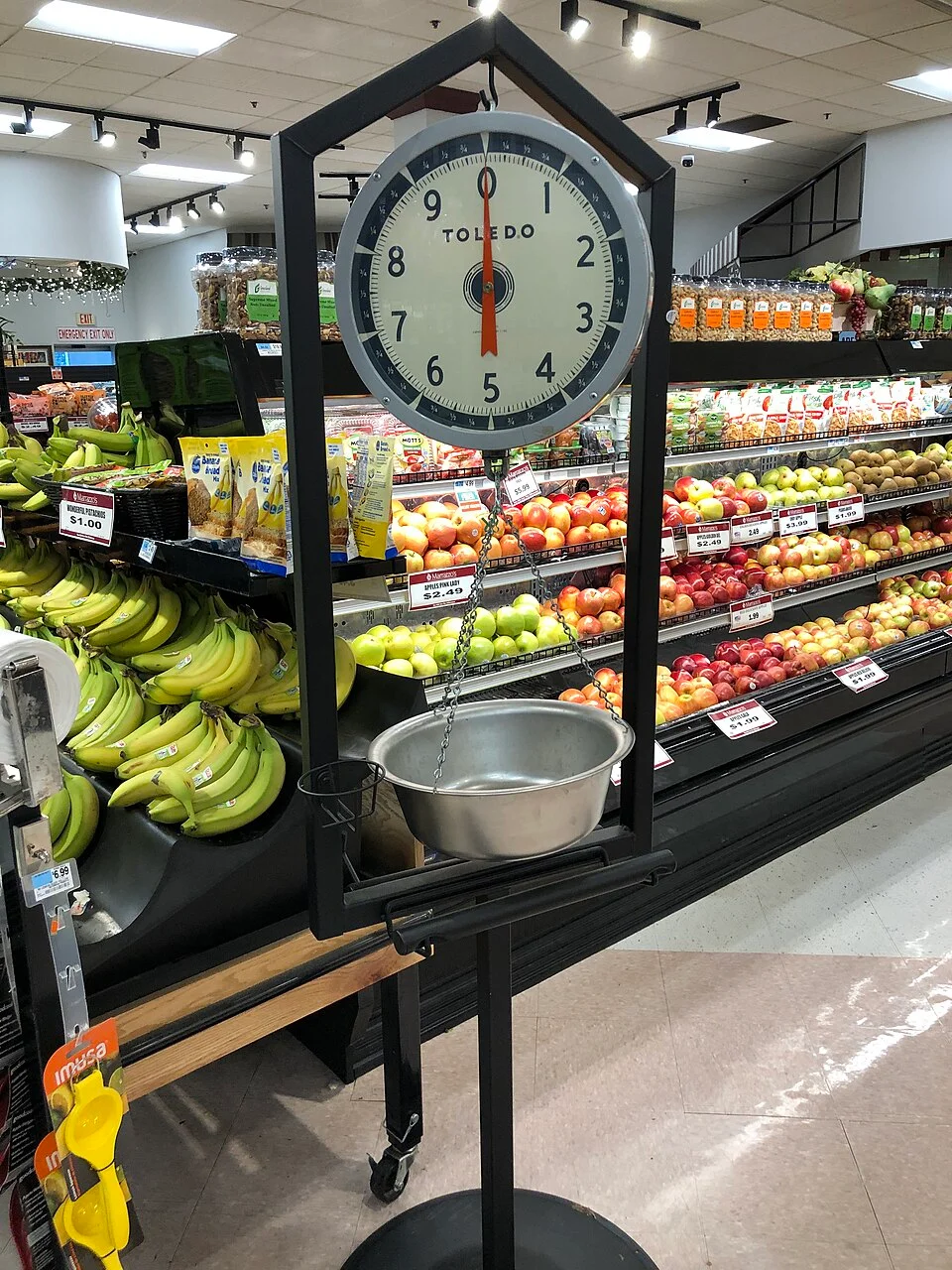
A hanging or counter scale in the produce section can help a shopper estimate the quantity chosen before they reach checkout. It may have no way to record a product code or a unit price. A checkout scale may use a completely different workflow, referring to an item record and laying out several fields on the receipt. Those are two different jobs. A photographer can document the presence of a scale at the shelf without telling us which instrument a store uses to charge for every item.
It is useful to make a rough check before concentrating on the last digit. If two apples weigh around half a kilogram and the price is four dollars per kilogram, the item is close to two dollars under these assumptions. Someone who receives a charge near eight dollars might first check the price unit, item description and number of items. The arithmetic may have been flawless on a lookup that used the wrong product. A second scale reading alone will not tell you that the unit price belongs to a different variety.
If the difference is small, consult the level of detail actually available. A scale's display changes in steps. NIST gives an example in which the displayed net, tare and gross are individually rounded, so adding the two displayed parts does not exactly reproduce the displayed total. That is possible without a change in the substance on the scale. The rounded readings are summaries. Two separate rounding decisions can differ from the single rounding decision applied to their sum.
A receipt can make the price check possible
A useful label records at least enough information to connect what was weighed to the amount charged. Given the product name, the billed weight and the posted unit price, a shopper can reconstruct the fictional 4.20 dollar charge above. If one field is unclear, the same shopper may only know that the final price felt high. A worker checking hundreds of items also benefits from labels that can be compared to the correct shelf price without opening the package.
Units carry some of the burden. A label showing 0.350 without a unit asks the reader to guess kilograms or some other measure. A shelf tag can quote a price per hundred grams while the till uses kilograms. The rate is equivalent if all the conversions are done consistently: 1.20 dollars per hundred grams and 12.00 dollars per kilogram in this example. The shopper's comparison gets harder when the two are placed far apart. A well designed sign gives the number and its unit the same visual attention.
The issue matters for someone buying a fixed quantity and someone keeping to a price cap. At a different fictional counter, a shopper with five dollars to spend at twelve dollars per kilogram can ask for about 0.416 kilograms without tax. If the clerk weighs the goods a little below the target first, the two can see whether to add more. If the term net is nowhere to be found and the scale still shows the packaging, asking which number sets the price is more useful than guessing why the clerk stopped adding olives.
Check the movement, not only the final reading
Packaging can also differ within the same order. Imagine a customer buys one portion to eat immediately and another as a gift. The gift goes into a different container from the first portion. Weighing both together and subtracting one tare would miss the fact that two pieces of packaging had been added. At a counter where the order is split this way, the worker needs to be able to track each package and its corresponding deduction. A receipt displaying two lines at the same unit price can then explain why the final prices differ: the proportions of food can differ even when the contents were sold from one tin.
Imagine an owner planning a small counter with paper bags, three sizes of tub and reusable containers brought by some customers. A good place to test the process is the moment the employee changes from one packaging type to another. Can the right tare be found immediately? If it is measured each time, does the employee know when the platform should be empty and when the container should be on it? Can the next worker recognise a reading based on a previous container? Those questions concern what people see while the transaction is under way.
NIST's public explanation describes inspections with test weights in the United States. It is a real example of checking a measuring instrument, rather than a promise about the inspection rules or every receipt elsewhere. Rules and procedures vary by jurisdiction. Within one shop, a customer with an unexplained price can start by asking how the weight and rate were determined. The receipt and the label give the counter staff a specific item and value to revisit.
When the difference is twenty grams, it takes the eye a moment to care. At the start of the transaction the tub and its lid are necessary and nearly weightless as part of the shopping experience. At the moment of calculation they are a precise amount. Someone at the counter has to say which weight is being sold. The price becomes easier to trust when the receipt makes that decision visible.